Beirut, the confiscated city: when public space becomes a battleground.
Houssam Mehfara - 24/10/2025.
From Raouché to Mar Mikhaël, from Solidere to Horsh, every corner of Beirut tells the same story: a city where the notion of the common good is constantly contested. Here, a coastal rock turns into a political screen; there, a pedestrian sidewalk sparks threats. Between erased memory and entrenched clientelism, Lebanon’s public space reveals the country’s fractures, and the rare victories of those still fighting to rebuild it differently.
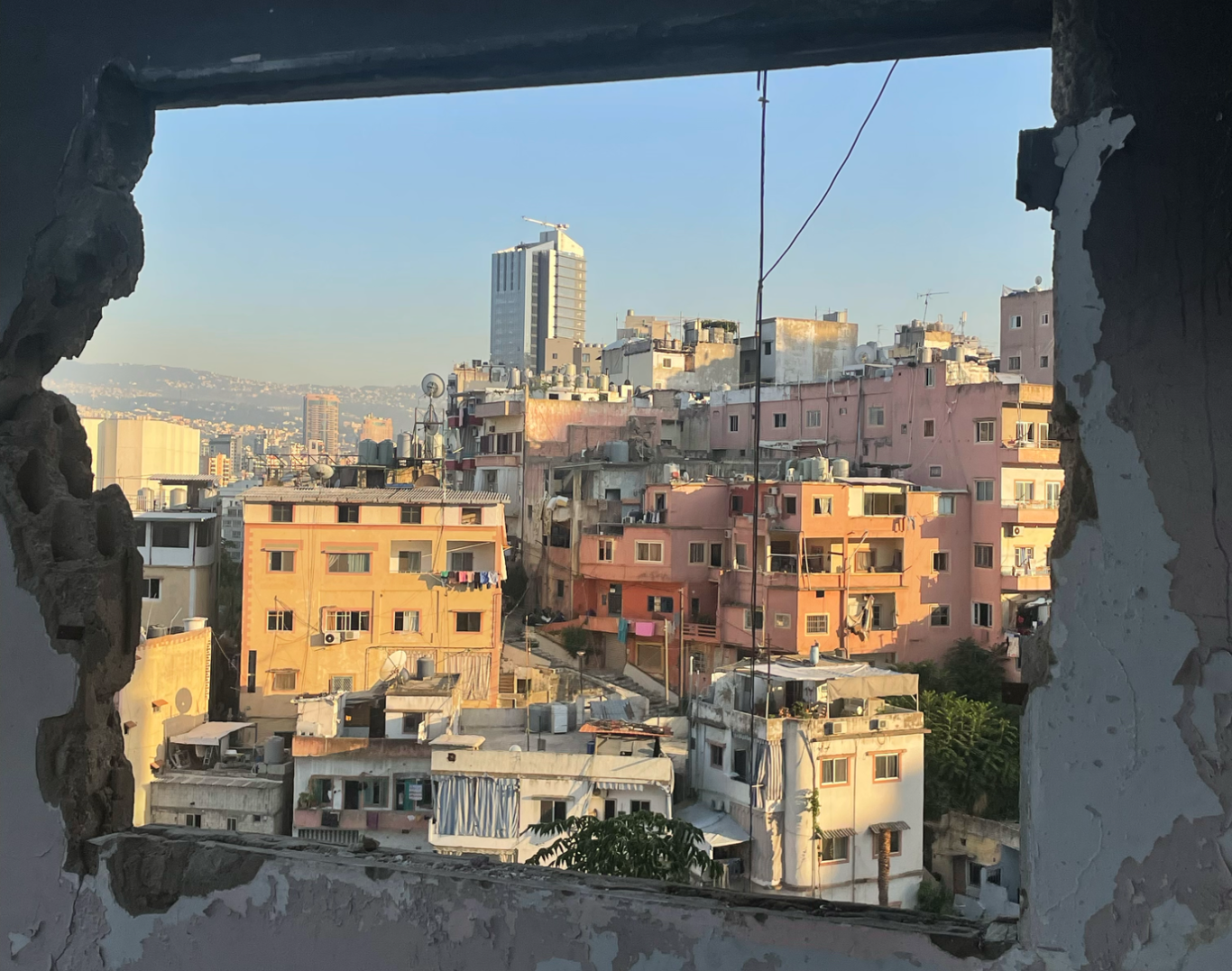
Window on Beirut. Credits: Victor Jardin
In Beirut, the news makes it clear: public space is never neutral. On September 25, 2025, in Raouché, the city’s iconic sea rock turned into a political screen when Hezbollah supporters projected the image of their missing leader, Nasrallah. A natural landscape became a political stage, reviving debate over what can, or should, be shown in the public eye.
A few kilometers away, in Bachoura, excavators tear through Roman remains to dig a parking lot. Here, collective memory gives way to economic expediency: public space becomes a stage for societal choices, where private and political interests trump heritage. Downtown, the immaculate yet hollow ‘faux souk’ of Solidere tells the same story in another form: a showcase without a people, a public realm turned private domain.
From Raouché to Bachoura, from the sanitized center of Solidere to the sidewalks of Mar Mikhaël, where a simple pedestrian project provoked threats and political backlash, the same question echoes: who owns the city, and what remains of the common good?
A Double-Faced Modernity
Public space reflects a society’s ability to coexist and to think of itself collectively.
Heir to a long urban lineage, from Roman ruins to Ottoman and French architecture, Beirut emerged after independence as a vibrant Mediterranean city: tramways, cinemas, souks, and cafés animated a downtown where all social classes once crossed paths. This vitality expressed a form of urban modernity built on openness and sharing, before the civil war fragmented both space and imagination.
Before the civil war, Martyrs’ Square and the surrounding streets made it possible for diverse populations to mix, socially and communally. Delphine Darmency, journalist and curator of the exhibition “Allo Beyrouth” at the Maison Jaune, recalls: “When you look at photos of downtown Beirut before the war, the city appears as a whole, with neighborhoods interacting and a beating heart. After the civil war, Beirut was carved apart by highways separating its districts, it lost its center, that place where everyone could gather.
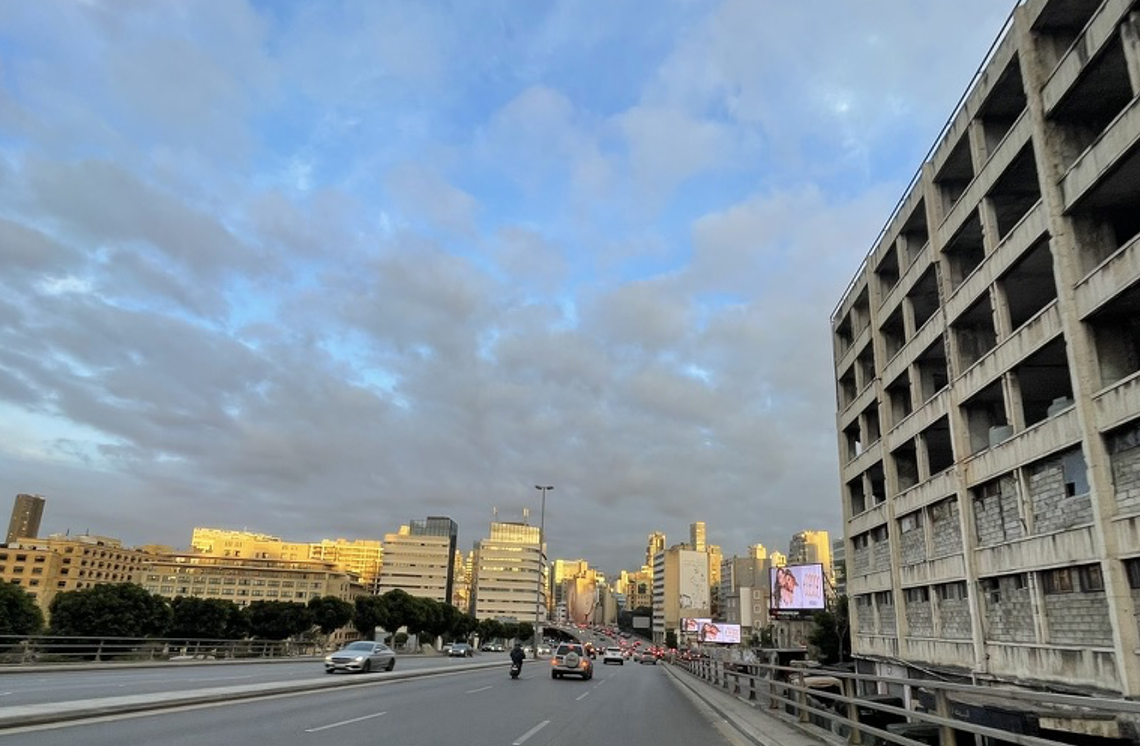
“The highway” that links—but also divides—West and East Beirut. Credits : Victor Jardin.
Between these two eras came the civil war (1975–1990), which tore apart the urban fabric as much as the social one. Downtown markets turned into no man’s land amid intense battles; hotels that once hosted the world became sniper nests on both sides. From gutted buildings to barricaded avenues, everything that embodied collective life transformed into a theater of siege.
The postwar years tried to fill those voids but often by replacing the lived city with a staged city. By recreating immaculate plazas and restored facades, reconstruction projects also erased traces and filtered uses. A public space is not just an open area with fresh pavement and new furniture: it is a system of practices, habits, and rights.
Rebuilding Downtown Beirutt: an urban illusion.
Nowhere is the hijacking of the common good more visible than in Beirut’s downtown, entrusted in the 1990s to the private company Solidere, controlled by former Prime Minister Rafic Hariri. The project, meant to revitalize the city center, became one of the largest transfers of urban property and identity in the Arab world.
On paper, it promised a renewed historic core: gardens, promenades, and a redesigned waterfront. In reality, it produced a ghost town: a pristine façade without inhabitants, where memory and social diversity were sacrificed for profit.
Solidere did not just rebuild walls, it expelled lives. Thousands of merchants and families, established for generations in the souks and homes of downtown, were expropriated — often by force. Those who refused to leave were evicted under pressure. The State, a silent accomplice, handed a private company the right to “replan” the capital’s heart. One of the most tragic consequences of the civil war was the capture of public authority by private interests.
Where merchants, artisans, and bustling cafés once thrived, there now stretches a closed-off district populated by banks and apartments unaffordable to nearly all Lebanese. As Delphine Darmency notes: “What Beirut lacks is its heart — there’s no longer a center where everyone can meet. Today, Beirutis have no reason to go downtown; it’s blocked by checkpoints, with no affordable cafés or real souks.” The promise of “a new center for all” turned into an enclave for the few, guarded by Solidere’s private security forces, whose uniformed men regulate behavior, screen passersby, and forbid photography.
In a country where public authority is fragile, this private police acts as a parallel power: a city within the city, a law within the law.
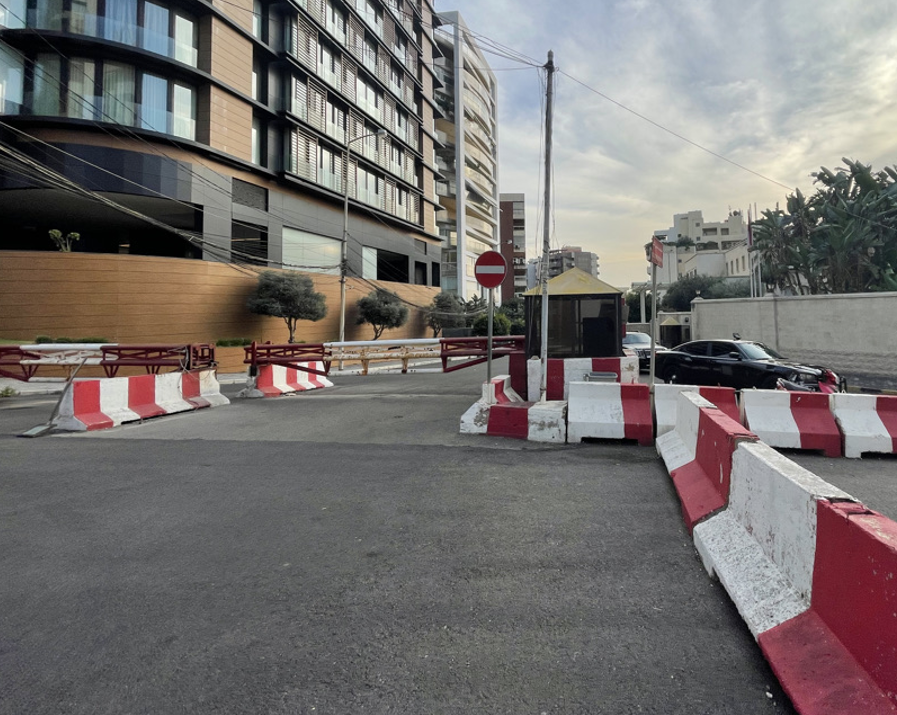
One of Beirut’s many checkpoints, here in the Verdun district. Credits : Victor Jardin.
In seeking to rebuild the city center, Solidere confiscated it, erasing memory and expelling its people. Where once echoed the cries of merchants, the smells of markets, and the hum of cafés, there now remains only a polite silence, a space “public” in name only. Solidere’s project was designed for the consumer, not the citizen.
The vanished grand park, the battle of everyday life
Another symbol, another timeline: Horsh, the largest park in Beirut, long closed to the public for security reasons, finally reopened in 2016 after years of citizen activism. For two decades, this vast green space of over 300,000 m²—one of the city’s few lungs, in a capital with only 0.8 m² of green space per inhabitant, remained inaccessible. Local petty authorities wielded security concerns as a pretext, exploiting sectarian tensions to block its reopening.
It took the relentless engagement of civil society groups to break the deadlock. Around Nahnoo, a collective of urban planners and citizens, a grassroots campaign took shape: symbolic marches around the park, public workshops, participatory mapping, and, above all, an irrefutable legal argument: municipal law guarantees free access to public spaces. Supported by organizations such as The Arab Center for Architecture, L’Espace Social, and UN-Habitat, the movement turned a technical issue into a citizen cause. Activists documented the site’s condition, organized events on its periphery, and launched a national petition demanding full reopening. They also forged an unprecedented dialogue with the municipal authorities (often perceived as opaque)proposing a shared management and maintenance plan, with opening hours, trained mediators rather than enforcers, children’s play areas, and supervision of sports and artistic activities.
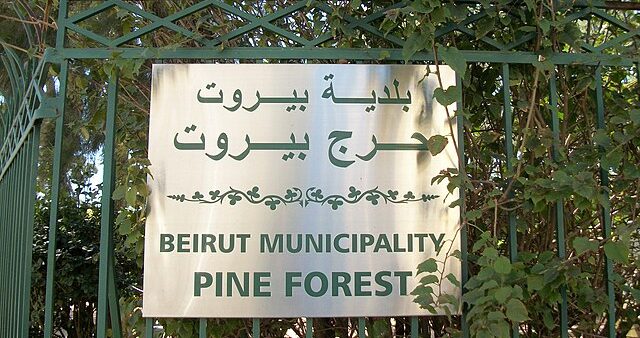
The entrance to the Horsh in Beirut. Credits : Patrice Bon.
When the gates finally opened, it was both a symbolic victory and a real-life stress test for the city. Horsh demonstrated that in Beirut, public space doesn’t operate by decree, but through governance: maintenance budgets, posted rules, human presence, social mediation. The park’s success lies in a patient compromise among institutions, civil society, and residents: a fragile but reproducible model.
Small projects that heal the city
Other modest initiatives, led by municipalities and associations, point the way toward better public space design. Two discreet cases tell the story more vividly than any speech.
In the Naba’a neighborhood of Bourj Hammoud, a 200 m² municipal plot squeezed between two gray buildings has been transformed. Once a vacant lot with an old kiosk, it now echoes with children’s laughter. A few wooden benches, three sparse trees, a makeshift fountain: nothing extraordinary, yet everything feels right. In the late afternoon, mothers gather, watching the children play with a distracted eye; elderly men exchange political news in hushed tones; a street vendor pauses, sets down his cooler, chats for five minutes. The ground is still too hard, the fence closes early, but the space breathes. It is clear that the neighborhood, not an investor, has reclaimed it. Behind this simplicity, civil society members organized participatory workshops to decide its fate: a little shade, but not too much; a fountain; fixed hours to avoid disputes. The park is no miracle, just a successful deliberative, citizen-led project.
In Mar Mikhaël, the story is more complicated. In March 2023, an urban project at the Gouraud–Pasteur intersectionaimed to widen sidewalks and turn the landing of the grand Gholam staircase into a small public square. The idea was simple: slow traffic without blocking it, make walking easier, and green the block. The municipal council approved it, the governor of Beirut authorized it; the project was expected to finish by July 2023. Reality intervened. Disinformation campaigns, political pressure, and threats on the ground forced the work to stop. The team revised the plans to address concerns: the roadway expanded to ~7 m, three delivery zones added, parking reorganized—all while keeping pedestrian priority. A petition signed by over 80 local residents, along with the support of hundreds of professionals, confirmed local backing. Nothing worked: when public space becomes a common good, it collides with entrenched interests - sidewalks claimed by shops, car priority, clientelist networks. The project became living proof that an alternative policy is possible, yet blocked by private and clientelist logics.
These two micro-spaces have become landmarks. Their value lies in embodying a social contract: they give form to public space based on sharing, clear rules, and the responsibility of those who use it. The essential lesson is clear: a city’s quality depends less on icons than on everyday use, and it is precisely what these small projects reveal, and what the system often obstructs.
The blocked memory
When I was in high school, history and geography classes ended with the Second World War. The curriculum concluded with Lebanon’s independence, as if on a victorious note. Nothing beyond that. Nothing on the civil war. Nothing on the fifteen years that shaped every street, every silence, every fracture in the country. The war existed only in family conversations, partial accounts, and “versions”: the uncle’s, the neighbor’s, each TV channel’s.
At school, the past stopped where the myth of national unity began. This institutional amnesia is visible in the city. Beirut rebuilt itself without an official memory. The books fell silent, and the walls eventually spoke, before being erased. In some neighborhoods, a few bullet-riddled buildings remain, like scars that no one had the courage to erase or the strength to confront. Most, however, have disappeared, swallowed by the logic of “new” and profitable. Urbanism has polished over the war.
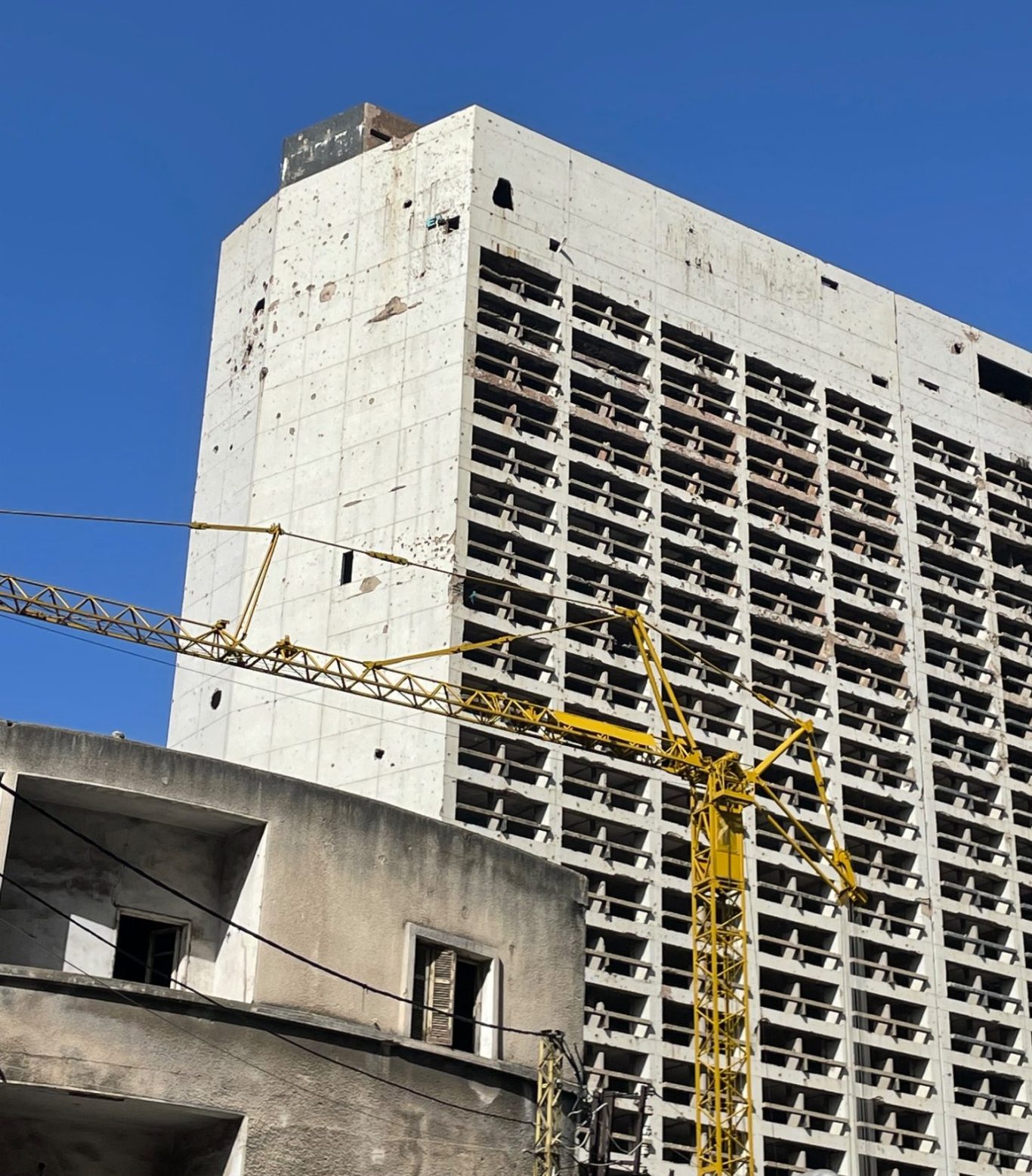
Bullet-riddled building on El-Béchir Street, in the heart of Beirut near the former “Green Line.” Credits: Victor Jardin.
Among the few exceptions, Beit Beirut (also known as “the Yellow House”) stands at the corner of Damascus Street and Independence Street, on the former frontline that divided Beirut during the civil war between Christian East and Muslim West. A survivor and witness, this building, converted into a sniper post during the war, has become a museum of urban memory, a space that bridges pain and reflection. Yet its mission remains fragile, almost solitary: it is visited more by researchers and foreigners than by Lebanese schoolchildren.
The truth is, the city is not lacking in traces; it is lacking a shared narrative. Ruins could have served as anchor points or spaces for dialogue. Instead, the preference has been to rebuild, erase, and turn the page. The downtown area, renovated to excess, flaunts ancient colonnades and restored façades while concealing the war that scarred it. Smooth memory has replaced living memory. This choice is far from neutral. A city that forbids symbolic disagreement risks, sooner or later, deeper fractures. Public space is not just scenery for a stroll; it is a place for debate, contestation, and collective life.
In Beirut, the proliferation of mobile barriers around political intersections and police lockdowns at the slightest gathering reveal a deeper truth: a fear of the collective. Evidence? Let’s go back to autumn 2019. The October 17 movement, the thawra, flooded downtown. Hundreds of thousands of people filled the streets, day and night. For my generation, it was the first time the city truly became a shared space, neither commercial, sectarian, nor controlled. Solidere’s frozen squares were swept into an extraordinary popular energy: tents appeared, debates erupted, songs mixed with slogans. Coffee, cigarettes, and ideas were shared. I remember feeling something I had never known before: I had found my people. Fellow citizens who resembled me without knowing me, sharing the same anger, tastes, and humor.
All this arose paradoxically from a known tragedy, the economic collapse, often called the national Ponzi scheme, patiently engineered by the state, stealing the future of an entire generation. In those nights, amid the tumult, we sang, laughed, and cried. Hope smelled of tear gas and Turkish coffee. For a fleeting moment, the country felt whole. Then it all went quiet. The squares emptied, old divisions returned, and life continued as if nothing had happened. The thawra faded, but it left a trace: proof, perhaps, that somewhere deep inside, Lebanon still harbors the desire for a shared space.
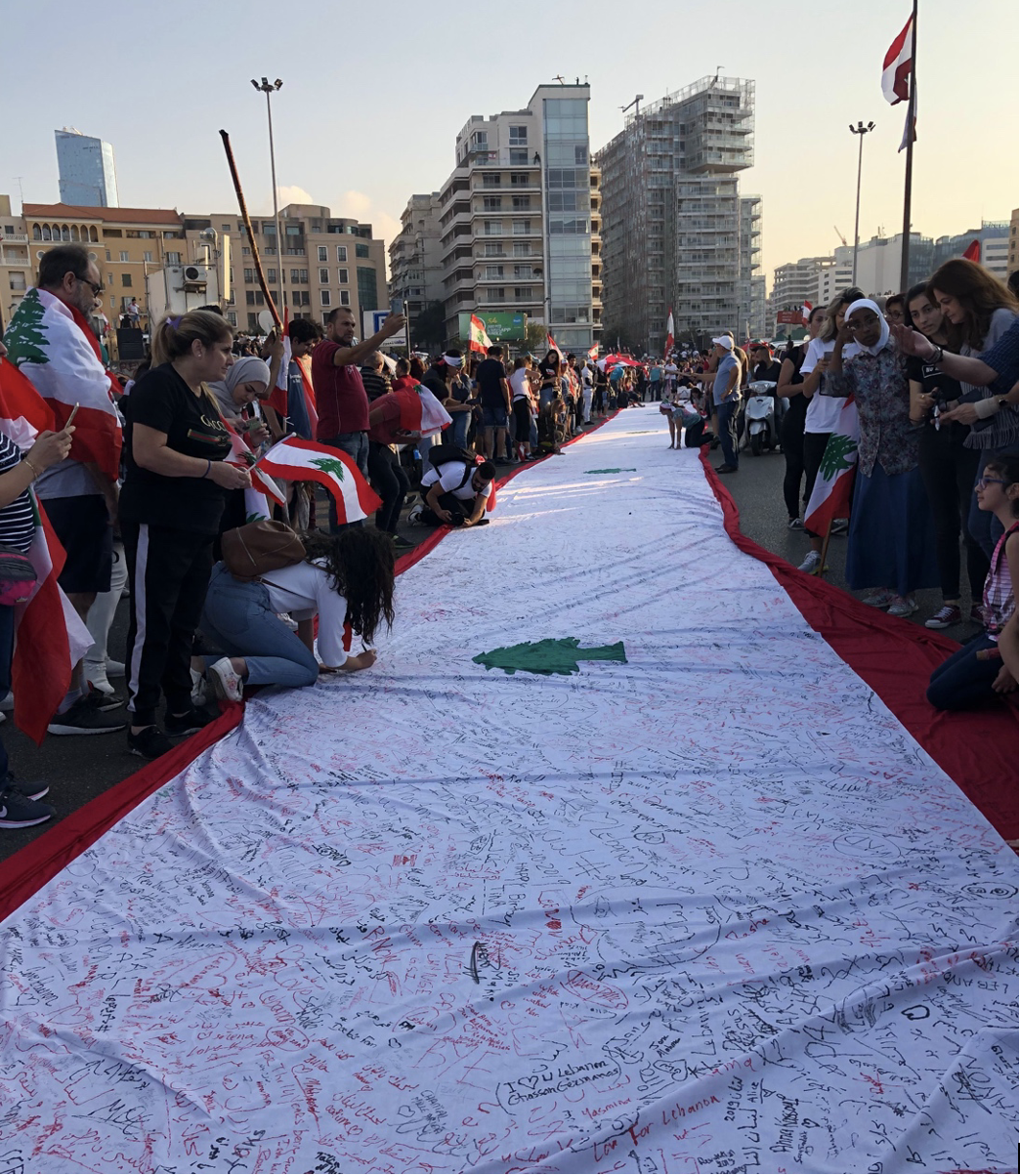
Downtown Beirut during the Thawra in October 2019. Credits: Houssam Mehfara.
A question of urban dignity
Lebanon faces extreme fragilities: a failing state, economic collapse, social crisis… Yet public space is not a luxury to indulge in once everything else works. It strikes at the heart of what a city promises: shared dignity, regardless of income or nationality. Its absence comes at a cost: retreat into sectarian enclaves, withdrawal into commercial bubbles, the feeling of alienation in one’s own home.
In Beirut, seemingly ordinary experiences (a neighborhood square reclaimed by children, a waterfront accessible without a fee, a park open without conditions) demonstrate that another path is possible. This approach does not seek to produce spectacular images; it seeks to rebuild connections: evening greetings, daily habits, shared appointments. The corniche remains a bastion of what the city can offer as shared space: as long as it remains continuous, free, and welcoming, Beirut presents itself as a living city, where people share the same horizon without protocols. The challenge is to replicate this logic elsewhere, on a too-empty square, beneath an overly noisy bridge, along a neglected sidewalk.
Lebanese public space has never been a gift; it is a patient conquest. And if the stakes could be summarized in one figure, it would be this: from 0.8 m² to 9 m² of green space per inhabitant, not to meet UN benchmarks, but to remind us that parks are the best way to combat urban fragmentation and create spaces that are truly accessible to all.
To go further :
- Why the Mar Mikhael project was stopped ? The Beirut Urban Lab's answer : https://beiruturbanlab.com/en/Details/1947
- About public space in Lebanese cities : Nazzal, M. and Chinder, S. (2018) “Lebanon Cities’ Public Spaces”, The Journal of Public Space, 3(1), pp. 119–152