Death of Saif al-Islam, the Qaddafi clan is no more.
Martin Amrouche - 09/02/2026.
Tuesday 3 February, Saif al-Islam Qaddafi, Mu’ammar Qaddafi’s favourite son, was killed in Zintan, in the north-east of the country. Shot dead by a commando whose motives remain unknown, the man who had escaped death on several occasions had become a troublesome figure for many actors, both inside and outside Libya’s borders.
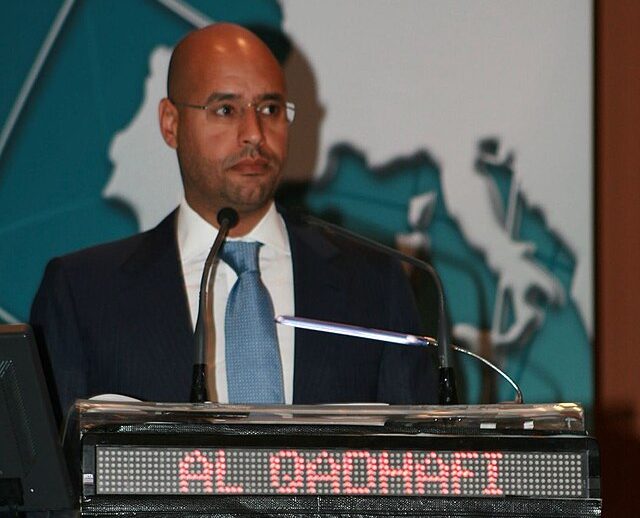
Saif al-Islam Qaddafi, 2007. Credits: Hamoom.
Following the announcement of Saif al-Islam Qaddafi’s death, reactions were mixed in this fractured Libya. While scenes of jubilation and even fireworks were reported in Misrata, the historic stronghold of the 2011 rebellion, sorrow and tears prevailed in Sirte, the native region of the “Guide” (the self-proclaimed title of Mu’ammar Qaddafi).
Information regarding the assassination of Saif al-Islam is slow to emerge and remains unclear. A commando of four masked men reportedly burst into the residence of Ajmeri Al-Atiri, head of the local Abu Bakr Al-Siddiq militia. After disabling the video-surveillance system—suggesting a high level of professionalism—the assailants shot Saif al-Islam and his protectors before vanishing without a trace.
In a statement, the Libyan Attorney General announced that the judiciary would take charge of the investigation in order to shed light on the assassination, whose sponsors remain unknown at this stage.
Saif al-Islam, trajectory of the Qaddafi clan's last figure
Killed at the age of 53, Saif al-Islam Qaddafi was a figure whose atypical trajectory illustrates Libya’s recent and turbulent history. The second son of Mu’ammar Qaddafi and his second wife, Saif al-Islam studied architecture in Tripoli before pursuing his education in Austria and at the London School of Economics, where he earned a PhD in 2008.
He quickly emerged as the promoter of an acceptable face of the Jamahiriya, the flattering name of the Libyan regime meant to symbolise the masses’ adherence to the Guide and his project. In London, he gave lectures on democracy, took up painting, and denied any intention of inheriting his father’s power.
Yet it soon became clear that Mu’ammar Qaddafi placed great hopes in his son, tasking him with exporting a polished image of the Libyan regime. Saif al-Islam then took the head of the “Qaddafi International Foundation for Charity and Development” and staged himself around the world as a disinterested philanthropist. Behind the scenes, however, a struggle for influence pitted him against his brothers, foremost among them Mu’tassim and Khamis, who embodied the regime’s hardest line.
Indeed, Saif al-Islam fashioned an image of a reformer and modernizer of Libya, which had been under the yoke of the Guide's dictatorship since 1969. He increasingly played the role of international intermediary, notably in compensating the victims’ families of the UTA Flight 772 bombing, ordered by the Libyan regime, which claimed 170 lives. At the same time, the prodigal son led a sulphurous lifestyle, multiplying lavish parties.
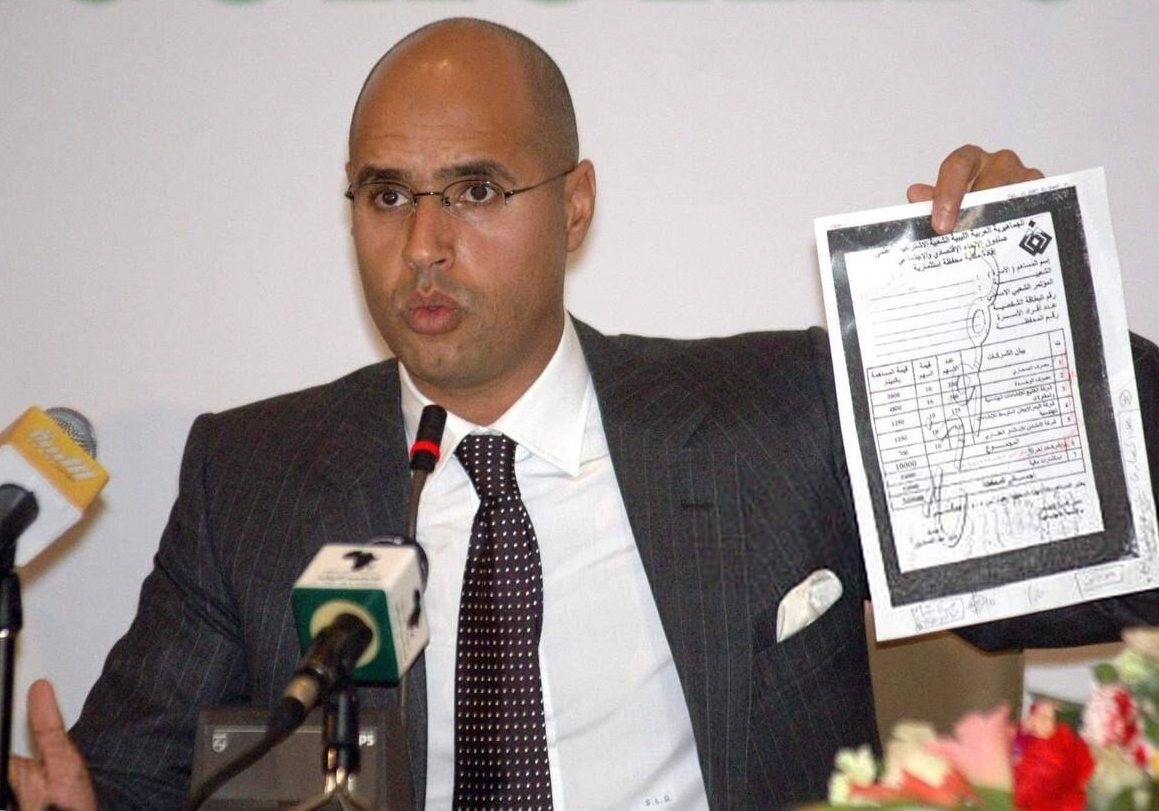
Saif al-Islam Qaddafi at a public meeting in Libya. Credits: Mohammed Hassan.
He appeared to gain influence with his father and, at the turn of the 2010s, emerged as the designated successor—just as the Arab Spring erupted in neighbouring Tunisia. In 2011, when protest spread to Libya, the façade collapsed and Saif al-Islam revealed his true face, promising “rivers of blood” to the revolutionaries whom he accused of being nothing more than a band of jihadists.
As NATO announced its military intervention and the situation deteriorated, he contacted Western chancelleries and offered to replace his father, promising far-reaching reforms. He may not have realised it then, but the damage was already too deep: Libyans wanted to put an end to Mu’ammar Qaddafi’s regime. The latter was lynched by a crowd in October 2011, bringing a 42-year rule to an end.
The Qaddafi clan was decimated, with his brothers Mu’tassim and Khamis killed. Saif al-Islam’s fate, as he went on the run, seemed sealed. He was captured in November of the same year by a Zintan militia (historic enemies of the Qaddafis), south-west of Tripoli. Images of him were broadcast showing a dazed man, part of his right hand severed. The Qaddafi Apollo was no more than a shadow of himself.
Wanted by the International Criminal Court for crimes against humanity and sentenced to death by Libya’s revolutionary courts in 2015, he nevertheless evaded justice thanks to the political calculations of the Abu Bakr Al-Siddiq militia, which saw in him a providential bargaining chip.
As Libya de facto split into two governments—Tripoli in the West and Benghazi in the East—Saif al-Islam went into hiding and very little information filtered out about him. He was released in 2018 by the militia that had detained him but did not leave the Zintan region, knowing he would be in danger elsewhere. Rumours flourished: he was said to be insane, deeply pious, ill. He would later learn to play on them.
Indeed, he resurfaced in 2021 in an interview granted to The New York Times. There, he appeared transformed, wearing a long beard and tribal attire, far from the jet-setter image previously associated with him. An expert in communication, he would then behave like an actor, playing on a carefully orchestrated mystical and quasi-messianic aura.
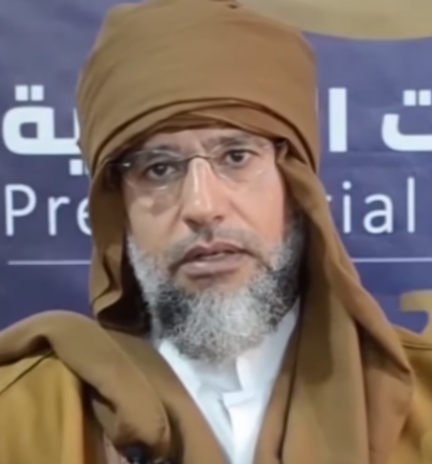
Saif al-Islam Qaddafi announces his candidacy for the Libyan presidential election, November 14th 2021. Credits : AL24.
That same year, he officially announced his candidacy for Libya’s 2021 presidential election, which was meant to be the first in post-Qaddafi Libya. This surprise candidacy reshuffled the deck and attracted the sympathy of many nostalgics who, if not regretting the Qaddafi regime itself, missed the country’s unity and stability.
Although planned for several years and backed by the international community, these elections never took place, officially for administrative reasons. Some argue, however, that Saif al-Islam Qaddafi’s candidacy—he was reportedly leading in some polls—posed a problem and was the primary reason for their cancellation.
A problematic return
This providential return of the last major figure of the Qaddafi clan suited no one. Libya’s fragmentation in the years following the fall of the Guide, while disastrous for the population, perfectly suits many national and international actors.
Officially at odds, the Tripoli government, recognised by the international community and led by Abdel Hamid Dbeibah, and the Benghazi government, led by Marshal Haftar, have been content with the status quo since the latter’s failed offensive in 2019. In reality, everyone benefits from it, including regional and international powers.
Turkey, Russia, the United States, France, Italy, Egypt, Qatar, the United Arab Emirates and many others all support one side or the other according to their interests, caring little about the reunification of this oil-rich Libya, where each seeks to secure its share of the spoils.
Thus, with the assassination of Saif al-Islam Qaddafi, it is indeed the preservation of the status quo that appears to have been completed. On 6 February, in Beni Oualid, at Saif al-Islam Qaddafi’s funeral, all Libyans—whether they hated or revered the man—may have witnessed the indefinite postponement of any short-term prospect of political change in Libya. Many are rubbing their hands.
To go further:
Martine Laroche-Joubert and Maryline Dumas, L'histoire de Seïf al-Islam Kadhafi, Arte. link to the documentary