"Syria is not in transition, this is a seizure of power"
Victor Jardin - 09/03/2026.
Interview with Firas Kontar, Franco-Syrian essayist and author of Syria: The Impossible Revolution. He campaigns for human rights and regularly contributes to French-language media on Syrian and Middle Eastern affairs.
Born in France and raised in Syria, Firas Kontar has closely followed the evolution of a country plunged into fourteen years of civil war since 2011. A human rights activist, columnist and author, he analyses for us the true nature of the power established by Ahmad al-Charaa since the fall of Bashar al-Assad, the persistent communal fractures, and the slim prospects for national reconciliation.
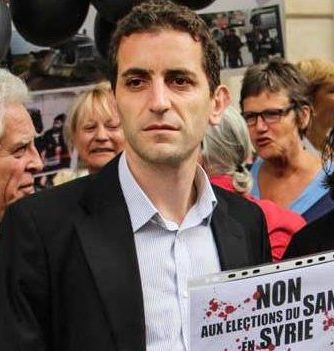
Firas Kontar. Credits: Firas Kontar.
Could you introduce yourself and your background, and explain the reasons behind your commitment to the protection of human rights in Syria?
Firas Kontar : I was born in Besançon. My father was completing a PhD at the university there thanks to a scholarship. I spent my early years in France — up to primary school — before moving to Syria in 1987, where I remained until I was twenty, first in the village of Dama, in the province of Sweida. I also attended the French school in Damascus.
That return was a shock. I was accustomed to the relative prosperity of France and suddenly found myself confronted with what I would describe as authoritarian state socialism. At the same time, the French school exposed me to an entirely different world: that of the regime’s children, of ostentatious opulence. This tension between two worlds shaped me. Very early on, I wanted to understand — and eventually to deconstruct — this dictatorship.
In March 2011, when the Arab Spring broke out, I was on holiday with friends. Watching Tunisia and Egypt tip over, I immediately thought that the protests would reach Syria. I booked a plane ticket and arrived in Syria in April. What I witnessed — demonstrations on the one hand, the regime’s repressive preparations on the other — led me to write a first article entitled “Syria: Bashar Prepares a Bloodbath.” I was far from imagining that it would herald fourteen years of crimes, one of the worst tragedies of contemporary history. That article was the first stone in a form of journalistic activism that I have never since abandoned.
My parents feared for my safety, and I left Syria fairly quickly. I was only able to return after Assad’s fall, in March 2025. In the meantime, I sometimes went to the Turkish-Syrian border to meet refugees and provide humanitarian aid, but I could not go any further.
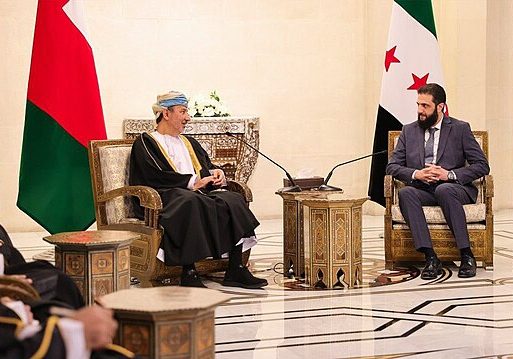
Meeting between Ahmad al Charaa and the Ambassador of the Sultanate of Oman to Syria. Credits: Ministry of Foreign Affairs of the Sultanate of Oman.
In your view, what legitimacy does the political and constitutional process put in place by the new authorities have?
This is not a transition process: it is a seizure of power. Syrian media themselves have almost entirely stopped using the terms “transitional government” or “transitional authority.” The regime has made a few gestures to show goodwill to the international community and facilitate the lifting of sanctions — a two-day national forum meant to symbolise consultation, a justice commission, symbolic communal representation within the government — but this was all a façade. On the ground, HTC (Hayat Tahrir al-Cham) and its allies have gradually taken control of institutions and administrations.
The Islamist imprint is becoming increasingly concrete. The governor of Latakia forced the closure of all establishments selling alcohol during Ramadan, with no indication as to whether they will reopen. At Homs University, in a mixed city, consumption during Ramadan was banned. In some regions, restrictions have been imposed on women’s makeup. These are not trivial measures: we are witnessing a deliberate effort to align Syrian identity with Sunni Islam.
This project also involves rewriting national history. May 6, Martyrs’ Day, commemorated the execution by the Ottoman Empire of around twenty Syrian intellectuals — a date that brought all communities together around a shared national holiday. Today, these figures, who were executed for calling for national independence, are viewed with suspicion by the new authorities. May 6 is no longer a public holiday following a presidential decree by the current president. The case of Sultan Bashar al-Atrash, the Druze leader of the Great Syrian Revolt of 1925 against the French mandate, is symptomatic: when government troops entered Sweida, they trampled and smashed his portrait hanging in many homes.
Can we identify continuities between Bashar al-Assad’s regime and Ahmad al-Charaa’s, or is the rupture total?
The security forces and the army were formally dissolved and replaced by HTC and its allies, mainly Turkish-backed rebel groups and Islamist factions. This is an entirely new institution, but it poses a fundamental problem: it in no way represents Syria’s diversity. Inherited from militias forged through fourteen years of war, this army serves to maintain power through force rather than legitimacy — exactly as under Assad. The army does not protect Syrians; it protects the regime.
As for the rest of the institutions, the structures were preserved but leadership was replaced: the Ministry of Culture, the Ministry of Education, public enterprises. Ahmad al-Charaa also established a parliament, partly appointed directly by him (70 members) and partly selected by a commission of grand electors that he himself designated (the remaining 130, of whom only 119 could actually be elected due to unrest in the northeast and the south). Since its establishment, this parliament has never convened. It looks more like a tool for rewarding loyalists than a deliberative institution.
The foreign minister, for example, has no qualification other than being a loyal fighter alongside al-Charaa since the earliest days of the rebellion. Through an opaque political bureau, he oversees part of state management. This is a far cry from the transitional government established by de Gaulle after Liberation, which brought together communists, Gaullists and representatives of all political currents and laid the foundations of the welfare state. In Syria, political parties remain banned, supposedly pending a law regulating political life. There is no debate about the form the state should take.
How might this regime evolve in the medium term? What political framework could better integrate the different communities?
I do not believe it is capable of reforming itself. Its strategy is to legitimise itself externally rather than internally. The support of the Trump administration offers it a convenient shortcut: “We are validated by the world’s leading power, therefore Syrians, submit.” Fourteen years of struggle for greater inclusivity have thus led to the same result: an authoritarian regime seeking legitimacy abroad.
This lack of openness and dialogue was evident during the events that shook the Druze-majority province of Sweida in the summer of 2025. Before the barbaric invasion of the Druze province, the majority of its population was rather favourable to the transitional government. But the massacres of Alawites in March 2025 generated deep anxiety about the new authorities. Instead of opening up and offering security guarantees to minorities, the regime sought to impose itself by force, sending troops into the province. The president exploited tensions between Druze and Bedouins to deploy his fighters under the pretext of acting as an intermediary. The worst-case scenario unfolded: Islamist forces massacred hundreds of Druze civilians, women were raped before being executed. Thirty-five localities were looted and burned. In my village in Sweida, everything was pillaged and destroyed by government forces, even though there was no armed resistance.
The regime blames Sheikh al-Hajri, portraying him as pro-Israeli, thereby turning a social problem into a political quarrel. Twenty-three members of my family were killed. How can one accept a discourse that attributes this violence to a “secessionist” sheikh? This government has been incapable of recognising the deep social wound inflicted on a segment of Syrian society.
I proposed a crisis-exit plan for Sweida, bringing together figures committed to Syrian unity. The government refused: it does not want to issue an official apology or withdraw its troops. It negotiates with Israel, not with us. Netanyahu seized the opportunity of the Sweida massacres to create a demilitarised buffer zone. This reveals the limits of legitimacy based on international recognition: the regime submits to an external actor rather than making compromises with its own citizens. The same logic applies to Turkish influence in the north.
What were the main pillars of your crisis-exit plan for Sweida?
In the short term, the plan rests on three pillars: security, justice and reconciliation. It first calls for the withdrawal of government forces from the province, accompanied by a reconstruction and compensation programme for displaced residents, Druze and Bedouins alike. On the security front, the voluntary integration of Druze fighters into the army and police would be subject to strict vetting: no criminal record, no loyalty to the former regime, and exclusive deployment within the province. Heavy weapons would remain in barracks; police would carry only sidearms. On the judicial front, independent courts would try those responsible for crimes, and public media would be obliged to document violations committed by both sides. Finally, sectarian hate speech would be explicitly criminalised.
In the medium term, the plan provides for local elections within two years to establish a provincial council with real authority over infrastructure, social policy and economic development. The opening of a border crossing with Jordan would stimulate the regional economy. Over a five-year horizon, three new faculties — agronomy, renewable energy and medicine — would anchor development in the long term. The core idea is to restore trust through concrete, verifiable guarantees, not promises.
What is the state of freedom of expression and relations between the state and civil society in Syria today?
The state is present, but a certain freedom of expression still exists, inherited from the revolution. However, it is eroding. Official media, such as Al-Thawra or the Sana news agency, systematically repeat government talking points. Individuals can still express themselves on social media, but their reach is incomparable to that of the state apparatus. Moreover, insecurity for journalists is increasing. I am thinking in particular of an Alawite journalist killed in February 2026 for criticising the government on Facebook.
An unfortunate reflex has taken hold: many revolution activists now support the government simply because it is Arab and Sunni. They refuse to see the sectarianism at work, because they themselves do not fear for their personal safety. The Syrian diaspora in the United States has also become an unconditional supporter of this government, perceiving it as the legitimate representative of the Sunni Arab majority.
This has been facilitated by a narrative attributing the suffering endured by Syrians over fourteen years of revolution to minorities. Yet the claim that Assad’s regime was “the government of minorities” is a lie. Assad relied on diverse clan-based alliances; the Sunni bourgeoisie of Aleppo long formed one of its pillars. He only instrumentalised minority protection from 2011 onwards, to rally them against the revolution. Many young Christians, Alawites and Druze fled for political reasons. From 2011 onwards, they went into hiding to avoid forced conscription into his army.
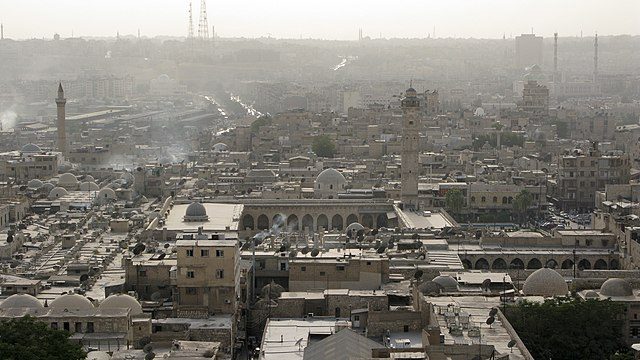
Great Mosque of Aleppo. Credits: Vyacheslav Argenberg, Wikimedia Commons
What is the economic situation one year after the fall of Bashar al-Assad’s regime?
Syria is becoming poorer. Qatar is financing some infrastructure projects, particularly in the electricity sector, and this year’s rainfall has improved water supply. But beyond that, the situation is deteriorating. A new caste has come to power, capturing and redistributing a few resources, striking deals with businessmen — but this benefits only a tiny fraction of the population, increasingly disconnected from a majority living in misery.
After fourteen years of war, a major international donors’ conference should have taken place. It did not. The authorities are waiting for Gulf investments, but these cannot meet the basic needs of a hungry population. People queue for gas cylinders. The grand symbolic projects dreamed up by the government are not the priority of ordinary Syrians.
Peasant agriculture should have been revived, artisans encouraged to return and develop their trades. Instead, the government announced mega-projects completely disconnected from Syrian reality: a media city, a Trump Tower and its golf course. The main improvement today is visible in the electricity grid, but the end of state subsidies decreed by the transitional government weighs heavily on household budgets already strained by poverty.
After fourteen years of war, do Syrians still aspire to live together, or have fractures between communities become insurmountable?
To begin building bridges, violence would have to stop — yet it remains daily. In the Homs region, armed men on motorcycles execute civilians every day. In such an environment of vendetta and revenge, how can one speak of appeasement?
The government organised what looked like a tribunal after the massacres on the Alawite coast. But NGOs documented a complete lack of will to punish the real perpetrators, who occupy positions within the Ministry of the Interior. The regime’s only real policy toward minorities is submission by force. We see the same dynamic observed after Saddam Hussein’s fall in Iraq, when part of the new Shiite elites allowed communal hatred to guide their exercise of power.
Are you more optimistic about Syria’s youth?
I fear that if young people do not express strong and organised discontent, we will slide into a republic that uses religion to legitimise authoritarian power. Many young people are ready to accept this direction, traumatised by fourteen years of war. I understand the exhaustion and the desire for someone to take the reins. But it is precisely this despair that the regime exploits.
I spent fourteen years documenting and denouncing Assad’s crimes. Today, I cannot align myself with this new power, which divides, which considers minorities responsible for their own suffering, and which is driven by a spirit of revenge. I want to return to Syria. But I receive numerous threats: I am accused of being an Israeli agent, a traitor. I do not know whether that return will be possible any time soon, even though it remains my deepest wish.
To go further :
Firas Kontar, Syrie, la Révolution imposible., Éditions Aldéia.
Opinion piece by Firas Kontar in Le Monde : « Après la chute de Bachar Al-Assad, il aurait fallu panser les plaies béantes laissées par treize années de guerre » .