Is the Arabic language in danger ? (2/2)
18/12/2025
fusḥa, the standardised language common to the 22 states of the Arab League, is a unique linguistic case in the world. It is an ‘official’ language, as opposed to ‘spoken’ languages, or dialects. Indeed, fusḥa is mainly used in politics, the media and literature. At the same time, each country has its own distinct dialect, which is what the Arab peoples speak.
However, in the context of International Arabic Language Day, it is important to consider the potential decline of fusḥa which, although often opposed to dialects, could lose ground to foreign languages such as English, French, German, etc. Indeed, it is no longer rare to encounter Arabic speakers who abandon their own language in favour of a foreign language for professional or social status reasons.
In these two mirror interviews, we will ask Qoutaiba Mardam Bek and Tarek Abouelgamal, both Arabic teachers in France, about the reality of this decline for fusḥa, the reasons behind it and possible solutions.
“Language has become a symbol of social status".
Interview with Tarek Abouelgamal.
For Tarek Abouelgamal, professor of Arabic and sociolinguist, languages deserve to be analyzed from every angle. From colonization to the Naksa, he looks back in this interview on how Arab populations’ relationship to language has evolved. From identity crucible to social status marker, from pride to self-rejection, language acts here as a revealing tool to understand the transformations taking place in Arab societies.
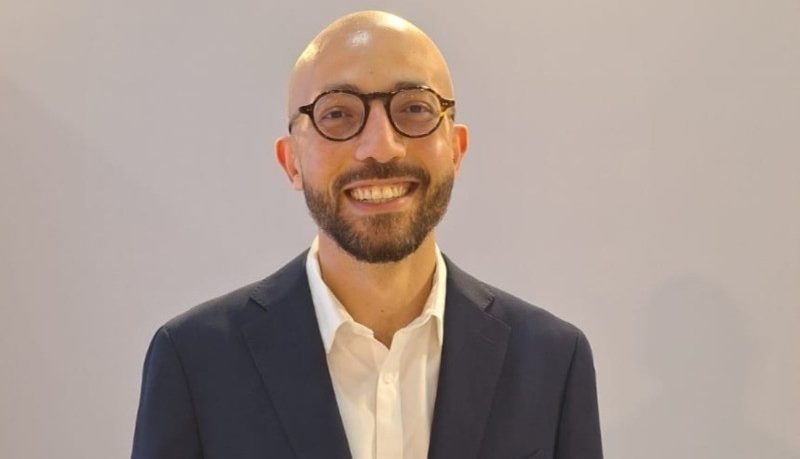
Tarek Abouelgamal, arabic teacher in France. Credits: Tarek Abouelgamal.
Where did your desire to teach Arabic as a foreign language come from?
My desire to teach Arabic developped in France. I arrived in Bordeaux at the age of 19. I was studying French and it began with my classmates back then; I used to help them with their Arabic courses. Over time, I improved my French, and I had the advantage of living in France, meaning I was constantly immersed. From there, I started teaching. It wasn’t easy, because I had to take a great deal of distance from my mother tongue and simplify it, which is anything but obvious.
More broadly speaking, my interest in languages goes back to before I arrived in France. In Cairo, I was already studying Persian at university and at the same time I was learning Turkish and German. With French and English, that makes five languages apart from Arabic. So I’ve had an interest in languages for a very long time.
Between Classical, Modern and Quranic Arabic, how would you define fuṣḥā?
Classical Arabic is defined by two things. First, time: “classical” refers to the antiquity of the language and is therefore defined in opposition to Modern Arabic. Classical Arabic is also defined by its corpus, essentially the Qur’an and pre-Islamic poetry. In this sense, classical Arabic and Quranic Arabic already overlap to some extent.
This classical corpus is roughly 50% Qur’an and 50% poetry. Even the Arab grammarians who worked to legitimize the Qur’anic text often used poetry as reference, which may seem paradoxical. It is not paradoxical from a secular perspective, but from a religious one it is: the Qur’an is a revealed text from God, descending to humankind. From a religious viewpoint, it is strange to explain a divine text using a corpus that necessarily comes from humans.
Then we have Modern or Standard Arabic. The adjective “standard” is very important and comes from the fact that it is the language of the modern Arab nation-state, meaning the 22 member countries of the Arab League. It is the language learned at school, the language of the media. It is the nation-state standard par excellence.
The other terms we often hear are “literal” and “literary.” We even find them sometimes in textbook titles but personally, I don’t really use them. “Literal” refers to something written exactly as it is, which in my opinion doesn’t mean much. “Literary” limits the language to literary texts, which is not the case. So, I would rather speak of Classical Arabic and Modern Standard Arabic, alongside all the dialects with their historical and contemporary richness.
The problem with all these terms is that they are often borrowed from English. In Arabic, we generally only find two opposing terms: fuṣḥā on the one hand and ‘āmmiyya or dārija on the other. Dārija is used rather in the Maghreb and ‘āmmiyya in the East, but both refer to dialect.
Some sociolinguists have suggested another distinction in recent years. Since fuṣḥā is actually a superlative meaning “the most eloquent language,” some have proposed introducing the term faṣīḥ, meaning “an eloquent language.”
There is also a terminology that I really like, formulated by the scholar Saïd Badawi. He identifies five varieties: Classical fuṣḥā, Modern fuṣḥā, and three varieties of ‘āmmiyya: the dialect of intellectuals, the dialect of educated people, and the dialect of illiterate people. The paradox is that intellectuals and educated people, some of whom abandon Arabic, end up being less Arabic-speaking than illiterate people. Yet today society values more those who mix Arabic and English—something unbearable for many—than those who speak only Arabic but are illiterate.
People often speak of a “decline” of fuṣḥā in Arab societies. Do you share this view?
Yes, there has indeed been a certain trend over the past few years, even though we don’t yet have statistics across the entire Arab world to speak of a real decline.
However, we must clarify which historical period we are comparing with. If we compare with the 1970s–1980s, the first generations of independent Arab nation-states with a more efficient public school system than the one in place today, the decline is indeed visible. But if we go even further back, before independence, there was no public school system and people were therefore less literate than today.
In the case of Egypt, with 40 million inhabitants at the time of Nasser, school systems were more efficient than today. I feel that the social contract in Egypt regarding education, but also many other issues, is falling apart. The Egyptian population was 70 million in 2000; today it is more than 105 million. Officials sometimes clearly state that the State can no longer guarantee quality education for all children, and that public free schooling is so poor that parents are better off sending their children to private schools.
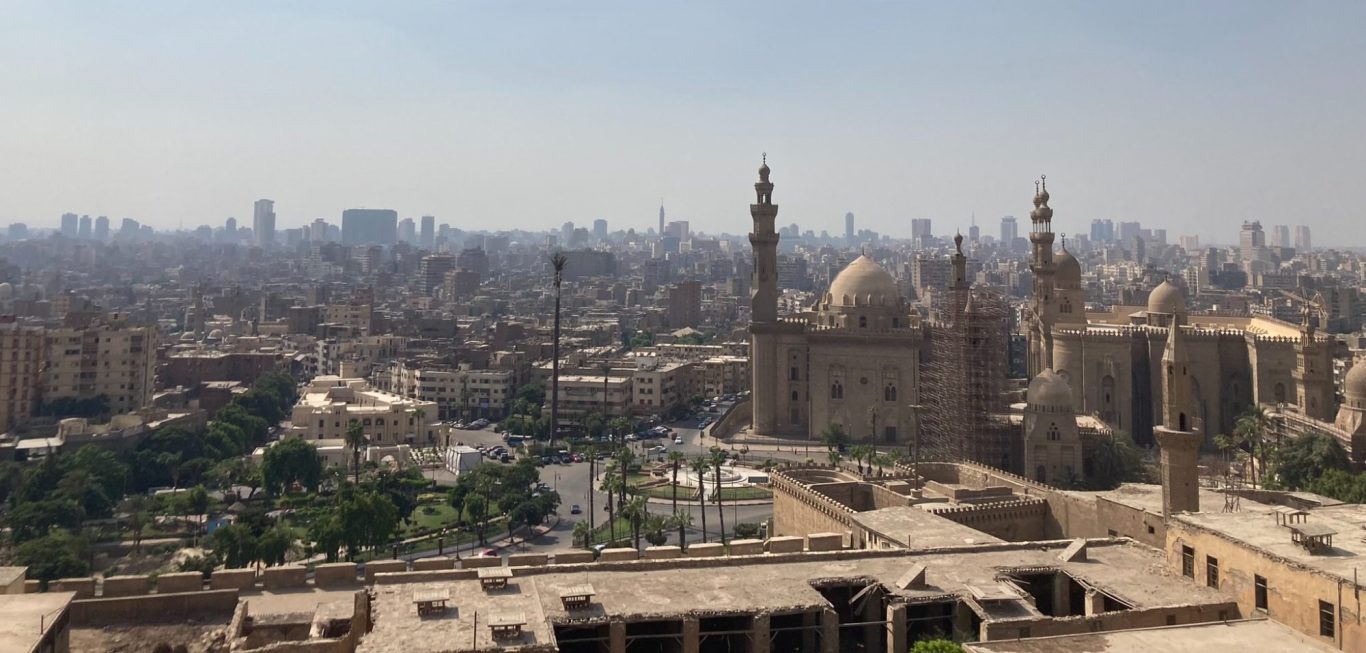
View of Cairo from Salah ad-Din's citadel. Credits: Martin Amrouche.
Fuṣḥā coexists with dialects in all Arab countries. Has this relationship evolved? What influence do dialects have on the learning of fuṣḥā?
Yes, I think there is an influence, because they have always coexisted.
I have an idea that diverges a bit from the general consensus on this subject. In my opinion, the Nahda of the 19th century, often described as a largely positive phenomenon, is actually the starting point of many linguistic problems we face today. Despite many positive influences, this movement functioned through exclusion. I think what we call Modern Standard Arabic is the result of the Nahda and its desire to create a new norm, a new fuṣḥā, just like in the 7th century with the rise of Islam and the writing of the Qur’an.
My interpretation is that in the 19th century, by creating a new fuṣḥā, many varieties were excluded and eliminated, even though they were no less Arabic than others. With the Nahda, we also witnessed a kind of “victory” of the Eastern Arab world over the Maghreb, with the elimination of Maghrebi words not used in the East, even though these existed in classical dictionaries.
In my view—and this is not necessarily shared by everyone—the Nahda thus downgraded many varieties that had always coexisted and created a new fuṣḥā considered difficult by many native speakers. This fuṣḥā becomes almost like an impossible love; everything is done to make it hard to reach. Perhaps there is a similar phenomenon in other languages with an unattainable “literary language” but the scale of this duality in Arabic is unique. This Modern Arabic of the Nahda is therefore adopted at independence, taught at school, spread by the media, but is still today far from being mastered by Arabic speakers.
Do dialects represent a threat to fuṣḥā or, on the contrary, a richness?
Personally, I don’t think dialects are a threat at all, although many people would say the opposite. To me, they are not a threat, because they have always existed without making fuṣḥā disappear.
As a linguist, I reject the idea of language purity. This is something we often find in collective imagination, but it exists nowhere in serious linguistic works. Languages exist to evolve and mix.
However, Arabic is peculiar in that it has not really been reformed in 15 centuries. Societies evolve, people evolve, but perhaps we lack the courage to reform the language. For some, it is sacred—something I absolutely do not agree with; I do not see it as a sacred language. We keep far too much distance from it. I think there are around fifteen Arabic language academies, but they do not propose real reforms. They suggest marginal adjustments that are not followed by speakers anyway.
Has the good knowledge of fuṣḥā thus served as a socio-economic marker?
Has fuṣḥā really ever been a socio-economic marker? I think so, but we should not forget that for two centuries colonization relegated the Arabic language. The Arabic textbooks published in France and Algeria, especially in the 19th century, were only intended for French colonizers who wanted to speak with their servants. This implies that the others, the educated people, necessarily spoke French.
So I think that since colonization, there has been an effort to instill the idea that a monolingual Arabic speaker can only be a servant, destined to remain at the bottom of the social ladder. This devaluation of Arabic, even by its own children, is reinforced by colonization.
Again, if I take the case of Egypt, during British occupation many locals worked with the occupiers. We can call them traitors or collaborators, but they represented an important social category, and they spoke English. Naturally, they were well paid, hence the socio-economic dimension. Egyptians working with the British army before independence belonged to a privileged social class and were obliged to speak English. So I think this phenomenon has older roots, but it took its current shape with independence.
Once again, I believe this phenomenon goes back to the Nahda, which coincided with colonization. Western historiography often claims that the French expedition to Egypt sparked the Nahda, also known as the Arab Renaissance. This is somewhat doubtful and objectively false, as there were already scientific and literary movements under the Mamluks and Ottomans. But the argument of colonization was to claim that these societies were backward and that it was the white man’s duty to civilize them—the infamous “white man’s burden.”
To what extent can the schooling of privileged children in foreign institutions (American, French, …) contribute to widening the gap between upper classes and the rest of the population, and to the erosion of a (pan-)Arab identity?
It certainly does. Behind the linguistic aspect, there is the socio-economic aspect, education, and so on. In Egypt, it even becomes geographical. In historical Cairo, rich and poor neighborhoods are separated by a street; you can cross from one to the other in five minutes on foot. Today, with the new capital and the desert cities being built, social segregation is intensifying. Language obviously contributes to this distinction and division, in a way, between Masr (Egypt’s arabic name) and Egypt. And I imagine it is the same in many Arab countries.
So yes, I think this is an important factor and today it can symbolize social mobility. Mobility now happens through the education system and learning of a foreign language. What is very fashionable now in Egypt is German. This is interesting, as there is no historical link between Egypt and Germany, and German is far from being the most widely spoken language in the world. Does mastering German truly provide more professional opportunities? I’m not sure. But socially, it matters. Language has become a symbol of social status.
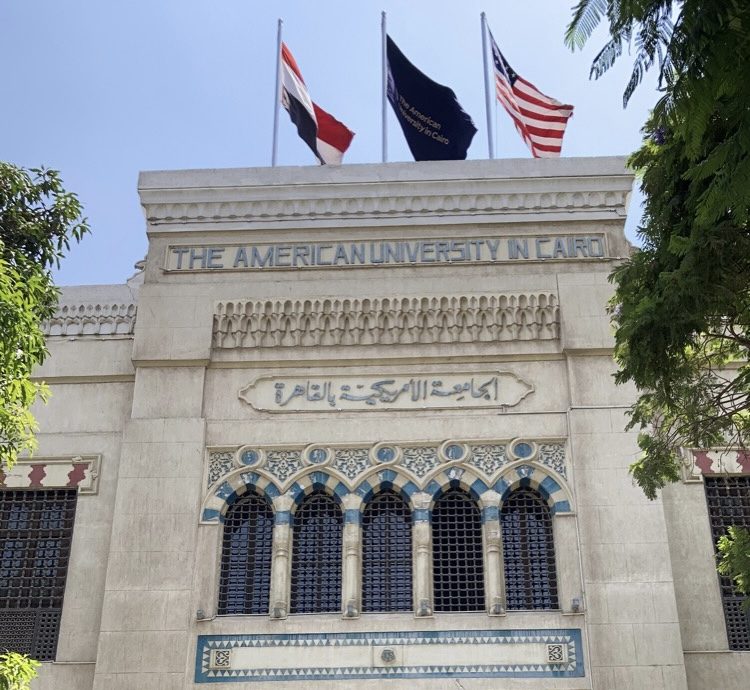
Front of the American University in Cairo's historic campus. Credits: Martin Amrouche.
According to some, one consequence of the failure of Pan-Arabism was the decline of Arab pride and the rise of a kind of “self-hatred” among Arab populations. Do you think this concept is relevant when it comes to language?
I agree with the general idea. To simplify things: with independence in the 1950s and 60s, up until the Naksa of 1967, there was a renewed sense of pride. But 1967 called everything into question. Five countries were occupied, governments failed to manage the situation, and the entire identity associated with Arab nationalism was shaken.
I think we have never truly gotten past the Naksa. The proof is that every misfortune affecting Arabs since then is always compared to it. In 2003, the invasion of Iraq was compared to the Naksa; what has been happening in Gaza is compared to the Naksa, and so on.
According to part of the Arab public opinion, what broke Arab unity was Egypt signing the peace with Israel in 1978, following the 1973 war. What some Egyptians consider a victory—recovering the Sinai—is seen by others as abandonment, since they failed to reclaim territories lost in 1967. This continues to resonate today, as shown by the recent decision of the new Syrian president not to celebrate October 6, 1973 anymore.
So there is a real division from that date onward. Other countries perhaps relied too much on Egypt, but all felt abandoned. I think we have still not overcome that moment, and much of today’s criticism of Egypt’s position on Gaza has roots in it. In any case, this sense of defeat is still present.
Paradoxically, in many countries we are seeing renewed interest in learning Arabic, increasingly valued professionally. How do you explain this phenomenon?
Quite a few things have changed. First, the Gulf region is wealthy and attractive to Westerners. There is of course the Dubai model, where Arabic is not necessarily needed, but in other cities, in Qatar and Saudi Arabia for example, Arabic remains very present.
Then it depends on the sector. In diplomacy or journalism, for instance, mastering Arabic is a real advantage. The fact that Arabic is a working language at the UN gives it particular importance, and all Arab heads of state deliver their speeches in Arabic. In diplomacy, speaking the other party’s language can be an asset. If I take the example of Egypt, I imagine negotiations for the Rafale purchase from France were conducted with interpreters, but if French negotiators spoke Arabic, it would certainly be appreciated.
What are the main challenges today in making younger generations want to learn fuṣḥā again?
I think there is a real problem in valuing pre-Nahda heritage. Perhaps people assume it is purely religious, yet the corpus is extremely rich and important. Avicenna (Ibn Sina), for example, is a global reference in medicine—to the point that a hospital in Bobigny (Île-de-France) bears his name. Many Arabs are proud of Avicenna, who is well known in the West, yet how many can read him in Arabic? The same goes for Averroes, Ibn Khaldun, and many other prestigious figures. Without fuṣḥā, their writings are inaccessible.
The absolute counterexample is modern Turkey under Atatürk, which, by switching from Arabic to Latin script, in a way cut itself off from its heritage. I do not wish for Arab youth to experience the same thing. We must promote fuṣḥā by highlighting the prestige and value of its corpus.
What I find paradoxical—and I even observe it around me—is that people feel proud to be Muslim, they are attached to the Qur’an, but cannot read it. There is something paradoxical in being proud of a language one does not master. It can even lead to misinterpretations of texts, which can be disastrous.
I think we must tell young people that they have the opportunity to connect to a rich heritage that has influenced the entire world. Those who may develop an inferiority complex should be reminded of Averroes and Ibn Khaldun, who influenced global thought. If other cultures value this heritage, Arab youth should do the same by reclaiming these texts in Arabic—their own language.