Jordanizing the Palestinian identity in the Hashemite Kingdom : the story of a national paradox.
Nadia Enesco - 03/11/2025
From 1948 to the present day, the Hashemite Kingdom has sought to domesticate an inevitable Palestinian “otherness” by assimilating it into its own national imagination. Out of this tension emerges a paradox: Palestinian identity forms both the material foundation of the Jordanian national narrative and its relegated footnote.
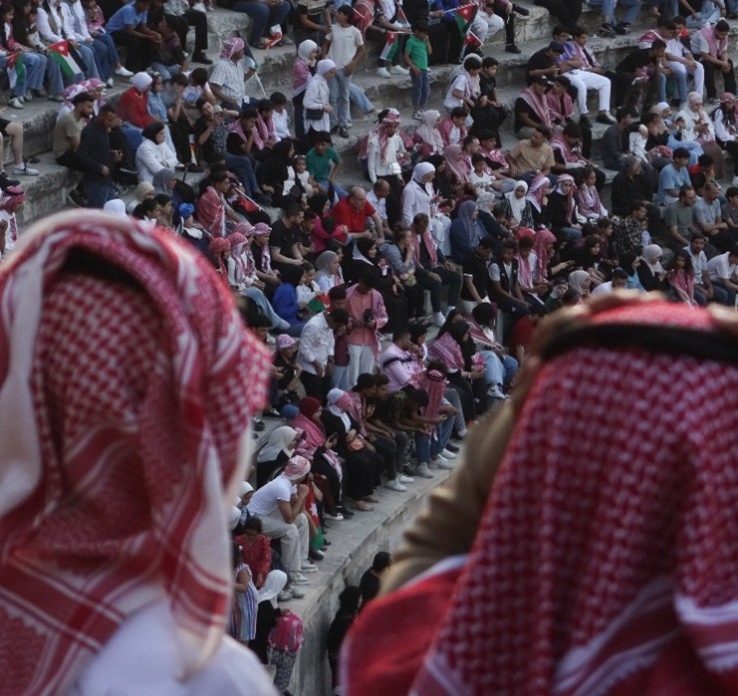
25 May 2025: Independence Day brings Jordanians together at the Roman theatre in Amman. Credits : Emile Bordes
A relatively recent state by regional standards, born in 1921 from the dislocation of the Ottoman Empire and the territorial recompositions of the British Mandate, the Hashemite Kingdom was built on a land lacking any real historical, linguistic, or ethnic homogeneity. Its population, then estimated at around 200,000, comprised Bedouin tribes, Circassian and Chechen communities, and a significant Christian minority. Amman, the future capital, was at the time a modest settlement without a distinctive dialect, largely inhabited by non-Arab families.
In this context, the construction of a Jordanian national identity was less a straightforward political or historical process than a performative one—a state-crafted narrative, a creative fiction [1] aimed at weaving symbolic ties among heterogeneous populations and giving form to a community yet to be imagined. Gradually, the state shaped this imagined community [2], built on a sense of collective belonging and loyalty to the monarchy. Conceived by the state and embodied by the throne, this narrative of unity served both as an instrument of cohesion and a mechanism of legitimation—one in which nationalism played a central role.
Government initiatives—particularly those led by the army and security forces—became the pillars of a top-down nationalism [3], drawing on tribal affiliations to anchor loyalty to the monarchy. Yet nationalism also manifested itself in the ordinary practices of daily life: a form of banal nationalism [4], reproduced through everyday symbols, gestures, and expressions. In Jordan, such markers are visible in diverse domains—sport [5], language [6], and cuisine [7] alike.
By attempting to forge unity out of diversity, this national project exposed the limits of its own performativity. The fiction of a homogeneous community collided with the reality of plural identities and deep internal divisions. These tensions become particularly pronounced when examining the Palestinian population, which constitutes a demographic majority and a central political issue. Since 1948, Palestinians have been both an integral part of Jordan’s social fabric and a mirror of otherness around which Transjordanian nationalism has crystallized. Their sheer numbers, their economic role, and their relative exclusion from political power have produced a fragile identity balance that the regime has continually sought to renegotiate.
The way this Palestinian “otherness” has been integrated into Jordan’s national narrative is telling—especially when traced over time. The state’s effort to assimilate this identity reveals the dual paradox of a “new” nation seeking to define itself while simultaneously mirroring its own internal heterogeneity.
On the one hand, Palestinian identity is constitutive of Jordan; on the other, the “Jordanization” of this singularity aims to dissolve it into a unified national story. Yet this superficial unification cannot erase structural differences or imposed inequalities—perpetuated both by the state’s narrative construction and its economic, social, and institutional policies.
Nakba and Forced Integration: The Price of Citizenship
The year 1948 marked a decisive turning point in the history of the Hashemite Kingdom. The Nakba—the “catastrophe”—triggered the exodus of more than 700,000 Palestinians expelled from their homes. Among them, nearly 70,000 sought refuge in Transjordan, whose native population barely numbered 440,000. This massive influx deeply altered the demographic and political equilibrium of a still-young kingdom.
In 1950, King Abdullah I decided to annex the West Bank, thus formalizing the “union of the two banks of the Jordan.” Officially, the goal was national unification: to build a single state transcending the division between Palestinians and Transjordanians. Yet behind this unifying rhetoric lay a pragmatic calculation—to prevent the emergence of an autonomous Palestinian leadership capable of rivaling the monarchy, while consolidating, through territorial expansion, the Hashemite throne’s legitimacy.
This redefinition of political and legal identity was enacted through the mass granting of Jordanian citizenship: 440,000 Palestinians residing in the West Bank, 280,000 refugees from territories newly taken by Israel, and 70,000 others already settled in Transjordan were all naturalized. Presented as a gesture of national unity, this mass naturalization carried a steep identity cost. By becoming Jordanians, Palestinian refugees were symbolically forced to relinquish a central part of their collective identity. On March 1, 1950, a royal decree even banned the use of the term “Palestine” in all official documents, effectively erasing the country from administrative language. The construction of national unity thus came hand in hand with a process of political and memorial erasure, transforming Palestinians into Jordanian citizens while denying the specificity of their collective experience.

Partially torn poster depicting a man wearing a black and white Palestinian keffiyeh. Amman, Jordan. Credits : Pierre Michaud
Economically, Jordanian citizenship facilitated refugees’ access to employment—especially in UNRWA services and in the booming Gulf economies. Labor migration, encouraged by Jordanian authorities, soon became a vital resource: before the 1990 Gulf crisis, remittances from expatriate workers accounted for nearly 28 percent of Jordan’s GDP. These transfers improved living standards for Palestinian families while shoring up the kingdom’s economic stability.
Yet integration came with social frictions. The massive arrival of refugees intensified competition on the labor market, depressing wages and fueling resentment among poorer Transjordanians. Many viewed as unfair the fact that refugees benefited from UNRWA’s social services—services from which they themselves were excluded. Although segments of the Palestinian bourgeoisie and notables did integrate into the kingdom’s elite—some even attaining ministerial posts—the strategic spheres of security, defense, and the monarchy remained firmly closed to them.
This policy of forced integration bred mutual distrust between the monarchy and its new citizens. The assassination of King Abdullah I in Jerusalem on July 20, 1951, by the Palestinian Mustapha Ashu, epitomized this unease. From that moment onward, relations between Jordanians of Transjordanian origin and naturalized Palestinians rested on an inherently unstable and asymmetrical balance—where proclaimed unity coexisted with deep-seated suspicion and the neutralization of difference.
The battle for the state: an impossible coexistence between the Palestine Liberation Organisation (PLO) and the monarchy (1967–1988)
The Naksa of June 1967 was another shock for Jordan and the entire Arab world. In barely six days, Israel inflicted a crushing defeat on the Arab armies and occupied the West Bank, East Jerusalem, the Sinai, and the Golan Heights. More than 250,000 refugees then crossed the Jordan River, increasing the proportion of Palestinians in the kingdom.
The Palestine Liberation Organization (PLO), founded in 1964, initially emerged from the conflict discredited; however, the defeat served as a catalyst: resistance factions reorganized within the PLO, Fatah gradually asserted itself, and under the leadership of Yasser Arafat from February 1969, the organization transformed into a military and social machine—external guerrilla operations, as well as education, health services, and pensions for combatants’ families.
Amman quickly became the main rear base for this strengthened PLO. Jordanian refugee camps supplied most of the recruits; in some regions, the now-majority Palestinian population made coexistence deeply paradoxical. On one hand, the monarchy initially tolerated the movement of these forces as a lever against Israel; on the other hand, the transformation of the fedayeen into an organized force—nearly 40,000 armed men—effectively created a state within the state, undermining royal sovereignty. At the core of the tension was a central question: the strengthening of the PLO’s legitimacy and political autonomy challenged King Hussein’s ability to maintain authority over Palestinians and consolidate a narrative of national unity.
Gradually, the increase in Palestinian operations from Jordan and the ensuing Israeli retaliations worsened relations between the resistance and the regime. In 1970, after an assassination attempt on King Hussein and hostage-taking incidents in Amman hotels, the Popular Front for the Liberation of Palestine (PFLP) hijacked several planes (the Dawson’s Field events) and blew up some of them in front of the press. On September 16, Hussein declared martial law and launched a major offensive against Amman and the Palestinian camps. The fighting—especially the Battle of Amman—claimed an estimated 5,000 to 10,000 lives. At the same time, a Syrian incursion intended to support the PLO was repelled with heavy losses. Although a ceasefire was finally signed in Cairo on September 27 under Nasser’s mediation, royal repression continued: the PLO was weakened, its forces evacuated, and Jordan restored control over its territory. “Black September,” with its human toll and the near-total expulsion of the fedayeen to Lebanon, marked an irreversible break between the Hashemite regime and the Palestinian resistance.
Exiled, the PLO nevertheless retained significant symbolic and organizational influence, which manifested on the West Bank, where its networks continued to operate despite Israeli occupation. On the Arab stage, the recognition of the PLO by the Arab League in 1974 as the “sole representative of the Palestinian people” marked the diplomatic victory of a movement that, despite its military defeat, had become a transnational political authority. The 1976 local elections, giving the majority to pro-PLO candidates in the West Bank, and the outbreak of the Intifada in 1987, confirmed the gradual loss of Jordanian control over the West Bank and the emergence of an autonomous Palestinian actor on the national scene.
The official disengagement of July 1988 formalized this evolution: by announcing the suspension of administrative and judicial ties with the West Bank and proclaiming “Jordan is Jordan, Palestine is Palestine,” Hussein closed the chapter on nearly forty years of diplomatic ambiguity. The gesture served several purposes: consolidating a distinct Jordanian identity, shedding the political burden of a contested territorial representation, and neutralizing the Israeli accusation that “Jordan is Palestine.”
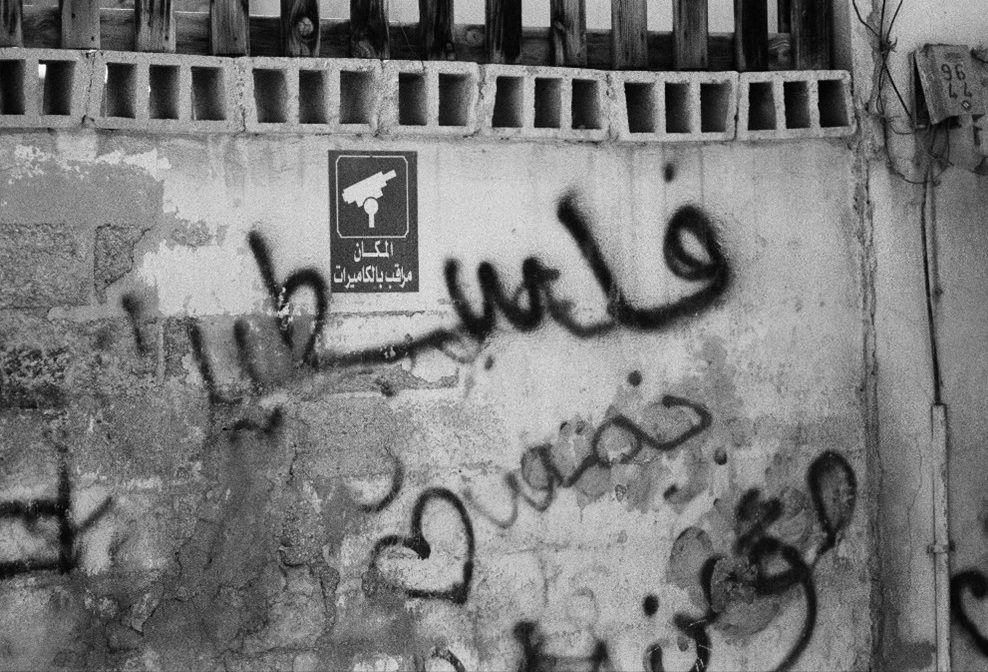
Graffiti reading ‘Palestine’ on a wall in the Palestinian refugee camp in Zarqa, Jordan. Credits : Pierre Michaud
State Pragmatism and Popular Anger: The Legislative Marginalization of Palestinian Rights (1990–2005)
Diplomatically, the 1990s marked the gradual erosion of the Palestinians’ right of return as a central principle in regional negotiations and agreements signed at the end of the century. Following the Madrid Conference, the Oslo Accords (1993) moved this claimed right to “permanent status issues” postponed to future negotiations, with no fixed timetable or firm guarantees.
The Wadi Araba Treaty (Jordan-Israel Peace Treaty, 1994) further shifted the diplomatic focus, establishing formal bilateral relations between Amman and Tel Aviv and addressing refugee issues indirectly through regional cooperation mechanisms—as a manageable humanitarian issue rather than an inalienable political claim. References to UN Resolution 194 [8] were sidelined in favor of a technocratic approach focused on “UN program implementation.” This dual strategic shift—relieving Amman of diplomatic burden and neutralizing the political impact of Palestinian refugees—permanently redefined the realm of possibility for them.
Even if Jordan continued to affirm its commitment to the principle of return, this stance was less a defense of individual rights than a strategy to preserve internal balance. Under this logic, Palestinian identity was marginalized, and any new influx of refugees was rejected, on the grounds that it would advance the “Zionist project” of an “alternative homeland” in Jordan. Beneath the official rhetoric, reiterated recently on the international stage [9], lay a desire to contain arrivals and encourage departures. This ambiguity thus transformed the right of return into a tool of political management rather than a mobilizing promise, revealing the tension inherent in the “Jordanization” of Palestinian identity: a state in formation confronted with otherness and collective memory.
The popular resurgence expressed in the Al-Aqsa Intifada (September 6, 2000) illustrated the failure of both Jordanian and international diplomatic efforts to capture Palestinian national energy. While some sectors of Jordanian society mobilized in support of Palestinians, demonstrating social empathy and transboundary solidarity, the monarchy faced a delicate balancing act: supporting popular momentum without triggering a rupture with Israel. The construction of the separation wall in the West Bank (June 2002) and the rhetoric of certain Israeli officials intensified fears of a massive population transfer to Jordan, putting Amman before a sovereignty and capacity dilemma. Under this pressure, the Jordanian state adopted a posture of closure: restricting visits from the West Bank, refusing entry to certain expelled Palestinians (e.g., Bethlehem in 2002), and blocking people at the Iraqi-Jordanian border in 2003. This choice was not merely bureaucratic; it was strategic: limiting unpredictable influxes to preserve internal order and avoid being perceived as the permanent receptacle of an imposed solution. Yet this pragmatic management nurtured profound political ambivalence: supporting a cause morally while excluding its victims materially reinforced a sense of institutionalized marginalization among many Palestinians.
Unite to Exclude: The Contemporary Jordanian Paradox (2005–2025)
Shortly after the outbreak of the Second Intifada, King Abdullah II launched the national campaign “Jordan First,” a deliberate initiative to reaffirm national unity in the face of internal and regional instability. Ten years later, the campaign “We Are All Jordan” followed the same logic. Both mobilized slogans, institutional measures, and public campaigns aimed at cementing loyalty to the homeland and promoting the idea of a shared Jordanian identity among all citizens. By affirming this unity, the kingdom sought to normalize the assimilation of Jordano-Palestinians into the dominant national narrative.
This unifying discourse also concealed Jordan’s refusal to absorb new Palestinian flows that could alter demographic and political balances—a phenomenon particularly visible in the last two years. In October 2023, the king publicly opposed any mass exodus of Gazans to Jordan [10], asserting that the Palestinian humanitarian crisis should be managed within Gaza [11]. The message was clear: “35% of our population are refugees… we do not want Palestinians coming to Jordan” [12]. This policy produced a clear political creed: unify internally without incorporating new demographic singularities, encouraging a Palestinian solution that bypasses Jordanian territory.
The concrete effect of this double discourse is structural. Administrative and political practices have developed, creating differentiated citizenship: arbitrary revocation of nationality for thousands of people of Palestinian origin in the mid-2000s, implicit quotas for sensitive positions, electoral districting favoring rural East Jordanian constituencies… All of these mechanisms, while not explicitly discriminatory, create a two-tiered society. Moreover, the management of camps and refugee populations crystallizes this ambivalence: rehabilitation programs and “reintegration” slogans coexist with humanitarian frameworks (UNRWA) and policies limiting permanent settlement. Where the state invests in infrastructure and services, it often does so in a logic of stabilization and control, not full political integration.
Yet the political and symbolic marginalization of the Palestinian component has not erased identity anxieties within Jordanian society. Since the 2000s, the resurgence of Transjordanian nationalism reflects persistent fears of a demographic and political upheaval capable of altering the very nature of the state. These tensions are also rooted in the kingdom’s economic transformation. Since liberalization at the end of the 1980s and the privatization of public sectors, Palestinian-origin elites have increased their influence in the private economy and financial circuits, while many Transjordanians, long supported by public and military employment, feel sidelined or threatened. The perception of growing inequality fuels a discourse of dispossession: “Economic Jordan” is Palestinian, “Political Jordan” is Transjordanian.
Recent national cohesion policies thus repeatedly clash with social, demographic, and regional realities. With fundamental stakes resurfacing with renewed vigor, the exclusion of new Palestinian flows and the persistent marginalization of those already established underscores how proclaimed unity remains both fragile and paradoxical.
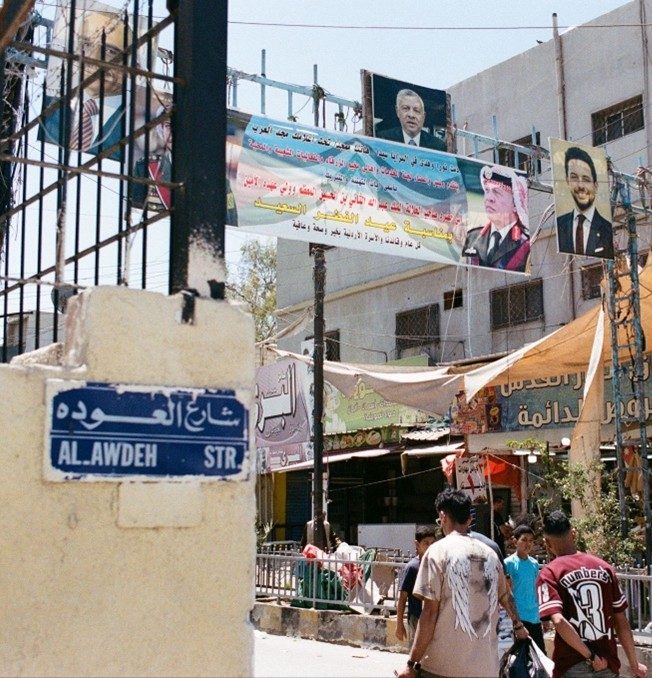
The ‘Return Street’ in the Zarqa camp, Jordan. Credits : Pierre Michaud
Thus, the “Jordanization” of Palestinian identity appears less as a coherent strategy than as a discordant governance regime. On one hand, Palestinian presence has been constitutive of the Jordanian state: massive demographic flows, human capital, economic transfers, and social dynamism have shaped the kingdom’s construction and development. On the other hand, state action has been limited to symbolic integration, framed by administrative and symbolic mechanisms prioritizing apparent harmony over substantive equality. This dual movement is the essence of the paradox: integration becomes a formal framework, a facade of belonging, rather than full political inclusion. The legitimization of displayed cohesion comes at a cost: it undermines the moral legitimacy of the state for a significant portion of the population and generates medium-term political risks.
This tension illustrates the difficulty for a young and heterogeneous state to translate a performative narrative into tangible political reality. Ultimately, this “Jordanization” cannot endure cloaked solely in red-and-white keffiyehs, symbols of Jordan that erase the Palestinian black-and-white keffiyeh. For this “fiction” to become genuinely creative, its symbols must descend into the realm of the real, translating the national cohesion narrative into actual rights and representation. Otherwise, displayed unity will remain a fragile set, behind which the fault lines of a divided society continue to run.
[1] Thiesse, 2000.
[2] Anderson, 1983.
[3] Massad, 2001.
[4] Following on from Billig's (1995) work on “banal nationalism”, Fox and Miller-Idriss (2008) revisited the study of this phenomenon.
[5] The rivalry between the clubs Faisaly (historically Transjordanian) and Wahdat (from the Palestinian refugee camp of the same name) illustrates the persistent tensions surrounding identity.
[6] The substitution of qāf with ‘k’ in the Palestinian dialect or ‘g’ in Eastern Jordanian dialect has become a social and political marker. In 2017, the president of the Wahdat Club pronounced Teklakūsh (‘don't worry’) in the Palestinian manner before later ‘correcting’ his pronunciation: phonetic choices do indeed take on an identity-related, even nationalistic, significance.
[7] Mansaf, a symbol of Transjordanian nationalism, contrasts with mulūkhīya, which is associated with the Palestinians. After Wahdat's victory in 2014, its supporters nicknamed the championship the ‘Mulūkhīya Champions League’, to which Faisaly fans responded: ‘Take your mulūkhīya and go to the bridge’, a reference to the Allenby Bridge, the border between Jordan and the West Bank.
[8] Refugees who wish to do so should be able to ‘return to their homes as soon as possible and live in peace with their neighbours’; others should be compensated for their property ‘as compensation’.
[9] In a speech to the UN General Assembly in 2024, King Abdullah II described the idea of presenting Jordan as an alternative homeland for Palestinians as a ‘grave mistake’. He stated: "That will never happen. We will never accept the forced displacement of Palestinians, which is a war crime."
[10] In Berlin, following a meeting with German Chancellor Olaf Scholz, he stated: ‘No refugees in Jordan, no refugees in Egypt; that is a red line.’
[11] Jordanian Prime Minister Jaffar Hassan emphasised that the kingdom rejected ‘any plan to displace or resettle Palestinians at Jordan's expense’.
[12] Quote from Ayman Safadi, Jordanian Minister of Foreign Affairs, during the 61st session of the Munich Security Conference.