The crisis of democracy: rethinking civic futures through the case of Lebanon. (1/4)
Victor Jardin - 10/11/2025
All over the world, democracy is losing its footing. Once hailed as the ultimate political horizon, the democratic model now appears fragile, contested, and sometimes hollowed out from within. From Washington to Warsaw, from Tunis to Ankara, polarization deepens, extremist movements gain ground, middle classes erode, and the shared foundation of civic values that once anchored democratic life seems to dissolve. Institutions struggle to keep pace with social transformations; politics, reduced to spectacle, too often fails to produce meaning or solutions.
Lebanon is no exception, it may even offer a magnified reflection of this global malaise. Here, decades of clientelism, corruption, and institutional paralysis have corroded public trust to the core. The 2019 uprising, the Thawra, embodied a cry for dignity and accountability, but also exposed the depth of structural rot. What followed has left many wondering whether reform is still possible within the country’s sectarian and oligarchic framework.
And yet, amid exhaustion and fragmentation, something persists. A counterweight to the system has been growing, made up of civic actors, reformist movements, and members of a far-reaching diaspora who refuse to surrender to despair. These individuals are experimenting with new forms of political participation, rethinking the relationship between citizens and the state, and trying to rebuild the idea of the common good in a context where it has long been confiscated.
This series of conversations explores that fragile but vital space where hope, reflection, and action still meet. Each interview approaches the crisis of democracy from a distinct angle. Together, these voices sketch the contours of a question that transcends Lebanon: what remains of democracy when institutions falter, and can society reinvent it from below?
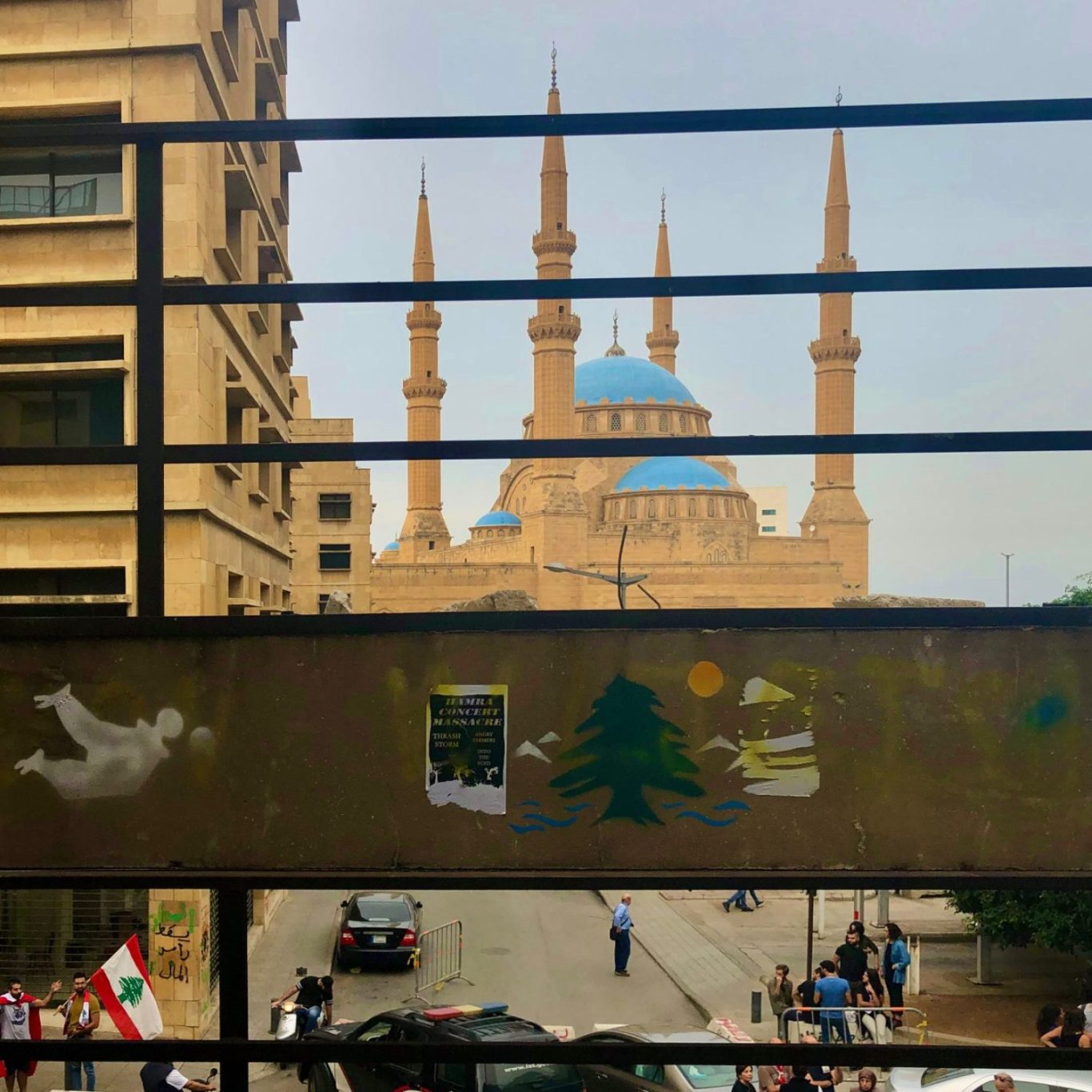
Mohammad al Amin mosque in Downtown Beirut during the 2019 Thawra. Credits : Houssam Mehfara
“Without a shared and inclusive vision, Lebanon is a doomed nation.”
Interview with Layal Beyhum
Founder of The Lebnene Ele youth-led initiative, an expert working at the intersection of youth, gender, education, and civic participation, Layal Beyhum represents a generation of Lebanese activists determined to rebuild bridges between citizens and institutions, including the diaspora. In this conversation, she reflects on the legacy of the 2019 uprising, the disillusionment that followed, and the crucial role the diaspora could play in the development of a “new Lebanon”.
AL MAWJA: The 2019 “Thawra” revealed the power of popular mobilization. How has it changed the relationship between Lebanon and its diaspora?
Layal Beyhum: The October 17 Revolution reawakened a deep sense of belonging and signaled renewed hope for a vast segment of the Lebanese, both at home and across the world. It particularly mobilized the youth and a large portion of citizens who had chosen to disengage entirely from Lebanese politics since the 1975 civil war.
Let’s take a quick snapshot of the basic facts. Today, there are more Lebanese living abroad than within the country’s borders. This mass emigration stems from the state’s repeated failure to ensure political stability, economic security, and access to basic services such as healthcare or education and, ultimately, the right to live a fair and dignified life. Lebanon remains one of the most literate nations in the region, yet it lacks the structural capacity to create an environment where people can safely raise families, where businesses can thrive, and where opportunities can truly materialize.
Lebanese voter turnout has remained chronically low since 1992, when nearly 70% of citizens boycotted the post-war elections. Despite slight fluctuations in subsequent cycles, participation continues to hover near the 50% mark, underscoring the enduring disconnect between citizens and state institutions. Meanwhile, the diaspora, who had been excluded from voting for decades, were only granted the right to vote in 2018. That year, voter turnout stood at 49.7% inside Lebanon and 59% among those abroad. By 2022, following the October 17 uprising, the devastating August 4 Beirut Port explosion, the severe economic collapse, and the COVID-19 pandemic, turnout inside Lebanon fell slightly to 48%, while diaspora participation rose to 63%. These votes were pivotal, helping elect 18 “change-maker” MPs unaffiliated with traditional political parties.
Protesting is not new to the Lebanese social fabric. Historically, people (including women) have taken to the streets since the 1920s to demand civic and political rights. Yet post-civil war, public mobilization shifted toward identity politics and foreign alliances, alienating over half the population and disillusioning an entire generation. What the Thawra achieved was a rupture in that pattern by restoring civic confidence (especially among the youth), reclaiming public space and political voice. It reminded them that not only do they have the right to be angry, but that this anger is an expression of belonging. The revolution transformed frustration into civic duty with accountability reinstated as the foundation of citizenship, and reconnecting Lebanon with its global diaspora through a shared demand for dignity and the necessity for political change. To me, this is the heart of the shift. The diaspora’s role has moved from sending money to redefining the momentum from humanitarian relief to socio-political engagement.
AL MAWJA: What was the revolution like on the ground? Was it truly organic?
Layal Beyhum: Of course, no protest movement is ever entirely organic. Yet in the case of the October 17 Revolution, the greater majority that took to the streets did so spontaneously, without realizing that any form of prior organization existed. At the time, I was completing my bachelor’s degree. I had friends that belonged to different political parties, and given that I was studying political sciences at the time, I often attended their events out of curiosity. I vividly remember being in a closed-door meeting around early October where discussions around planning a demonstration in Beirut were raised.
A few days later, following the devastating forest fires and the government’s absurd decision to declare on the media a potential tax on WhatsApp calls, people began to gather in the streets of Beirut. Others, seeing the scenes unfold, organically followed suit. Within hours, Tripoli and other cities had joined. What began as a small, semi-organized protest quickly cascaded into a nationwide movement.
The first weeks were nothing short of extraordinary. People from entirely different backgrounds came together, sharing food, chants and a shared feeling of relief. Mothers brought home-cooked meals to demonstrators, and families stood by the roadsides clapping in solidarity. For weeks, the main highway linking north and south Lebanon was blocked by civil society actors installing tents to ensure that the highway does not open before the parliament is dissolved. This carried such symbolic weight of a nationwide cry for unity and the desire for reform.
Over time, traditional political parties began to appropriate the revolution’s language and visibility, and what many of us annotated as “rekbo l-mawje” (they overrode the wave). This co-optation eroded the movement’s credibility and alienated many of those who had first taken to the streets in genuine hope of systemic change. Without a clear leadership structure or a unified framework of collective demands, the uprising gradually lost its compass. What had begun as a moment of unprecedented unity and civic awakening slowly fragmented, as demonstrations lost momentum and participants grew disillusioned with the lack of direction and the return of old political narratives.
Less than two months later, the Lebanese Lira collapsed, and all the banks froze every person’s assets. Then came COVID-19. Salaries disappeared, a curfew was imposed, and the collective energy that had once filled the streets turned inward toward survival. People eventually returned home suspended between exhaustion and the fragile hope that, someday, the unity they had felt in those first weeks might return in a more organized form.
AL MAWJA: And what about the diaspora’s role at that time?
Layal Beyhum: The diaspora proved to the world that they too, are deeply concerned and involved in Lebanon, and more importantly, their voices are equally as important as those residing in Lebanon. Coordination was deliberate yet decentralized. Traditional parties like the Lebanese Forces and Kataeb, which had long maintained strong networks abroad, helped organize rallies in places like the Trocadéro in Paris. Yet most people who joined didn’t know who had initiated them. What mattered was the feeling of unity, the realization that whether we were in Beirut or Berlin, we were demanding for accountability, dignity, and the right to live in a functioning state.
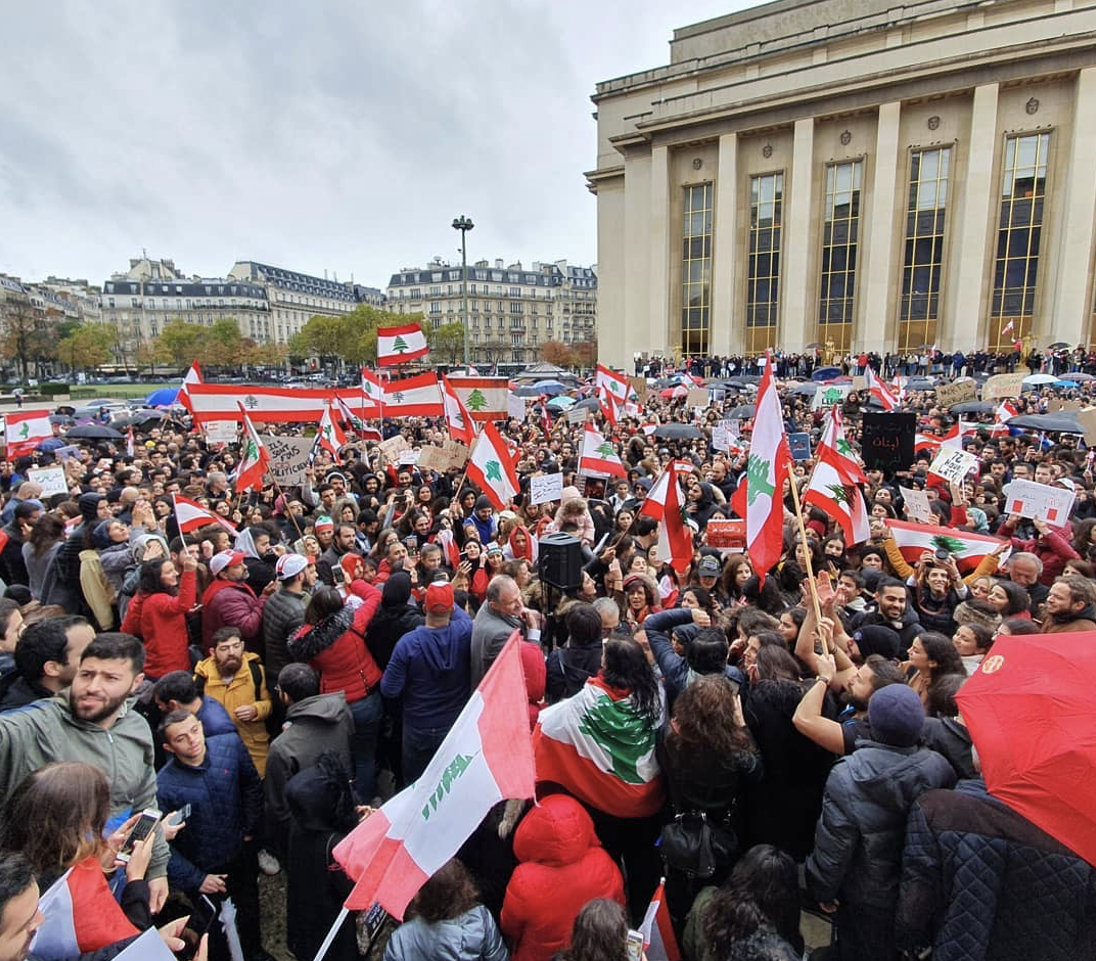
Lebanese demounstration in Paris, October 2019. Credits: The 961.
The strongest asset was social media. It became the thread that connected the homeland to its scattered people. Every chant that rose from the streets of Beirut, Tripoli, or the South was echoed loudly in Paris, New York, Sydney, Montreal, São Paulo, and countless other cities. Digital platforms collapsed geographical boundaries and turned outrage into a shared rhythm. For the first time, Lebanon was no longer confined to the soft nostalgia of its cuisine, music, and memories, but reimagined as a global political pulse demanding the transformation of a crippled system from within.
Then came August 4, 2020. The port explosion shattered whatever hope was left. There has been continuous obstruction towards the investigation. For many in the diaspora, something inside broke. People reverted back to their old habits of sending remittances and supporting humanitarian relief, but the emotional thread that had tied them to the revolution frayed. That’s when the tone shifted from “We can fix this” to “they killed us from the inside” The anger relatively shifted inward.
AL MAWJA: Has this experience changed how the diaspora relates to Lebanese politics?
Layal Beyhum: It really depends on the person; on how open they are to dialogue and to creating new spaces for political discussion. In Paris, for instance, I’ve attended roundtables bringing together people from across the entire political spectrum, and organized intergenerational dialogue and trivia nights. We listen to one another, debate, disagree, respectfully. That in itself fascinated me, because it’s something that almost doesn’t exist in Lebanon. It revealed just how deeply we lack genuine spaces for dialogue back home, and how deeply instilled by fear and inherited divisions the political culture has been.
Yet within the diaspora, especially among younger generations, something has shifted. There’s a renewed curiosity, and a desire to understand what’s happening on the ground, to follow the news, participate in talks and panels abroad. Politics has re-entered their vocabulary. Inside the country, however, the atmosphere feels heavier, because people are focused on surviving, making ends meet, and that daily struggle leaves little room for political engagement.
This growing political awareness among the diaspora is precisely why today Nabih Berri (Speaker of Parliament) is working to obstruct their voting rights. Over the past few years, numerous Lebanese collectives have emerged across Europe, the Americas, and the Gulf, mobilizing in lobbying efforts and global advocacy campaigns. They are gradually becoming a political force.
Still, even in that contrast lies something hopeful. The dialogue that has emerged abroad may one day reconnect with the last droplets of resilience that remains at home. And that, in itself, marks the evolution of Lebanon’s relationship with its diaspora, from one rooted in nostalgia and relief to one grounded in awareness and the determination to rebuild.
AL MAWJA: Many young Lebanese, both in the country and abroad, seem disillusioned. How can trust in politics be rebuilt?
Layal Beyhum: “Optimistic” is quite a strong word. Honestly, how are we even supposed to vote in the 2026 parliamentary elections? The diaspora still has fewer (if any) political rights than citizens living inside Lebanon. There is little at the moment that inspires genuine hope.
Still, there are evident actions of nonviolent actions. Youth groups are trying to organize and structure themselves with the older generations abroad. What I believe we truly need at the moment is a symbolic victory. We need something that proves the system can, in fact, be challenged. If the diaspora could secure equal voting rights, if we could pressure Nabih Berri to lift the restrictions that deliberately silence those living abroad, it would mark a turning point in modern Lebanese political life.
For trust to be rebuilt, representation must first be made real. Equal political rights for the diaspora would restore the idea that citizenship extends beyond borders and that every Lebanese voice, wherever it lives, equally counts.
AL MAWJA: The diaspora vote is often marginalized or even instrumentalized. How can its real political weight be strengthened?
Layal Beyhum: It’s not so complicated. Parliament could legislate equal voting rights tomorrow if it wanted to. The groundwork has already been done through sustained lobbying; 79 MPs have signed a document supporting this reform. Yet Speaker Nabih Berri continues to block it, refusing to bring it to the floor. We’re not dealing with a government in the institutional sense, we’re instead dealing with a system that operates like a mafia, protecting its own survival above all else. The Prime Minister could intervene, but he’s already engulfed by overlapping crises that leave little room for political courage.
That’s why the pressure must now come from outside. When I say outside, I do not mean through foreign intervention at all, if anything this has contributed to the country’s mass fragmentation. It needs to come from within, but our within comes from all those who were forced to leave for better living opportunities. I’d like to call it the external within. The diaspora has both the numbers and the legitimacy to influence the political course, but it needs structure. It must organize, coordinate, and speak with one voice. The diaspora’s strength lies way beyond its financial remittances or humanitarian networks. I’d like to believe that it can indeed redefine accountability from afar, to remind those in power that Lebanon no longer exists in isolation. Real change will not come from a single decree, it will come from a collective assertion that representation is a right, and not a privilege.
AL MAWJA: If you had to define three priorities for the diaspora to truly contribute to a “new Lebanon,” what would they be?
Layal Beyhum: First, we need a structured, clear and shared vision. What are Lebanon’s fundamental and universally accepted values, how do we see this nation functioning and what action-plan are we taking on, are the key questions that need to be answered. The diaspora must build organized and cooperative networks, cells that are interconnected and not competitive. There are initiatives already in place, but they relatively remain fragmented and often weakened by ego. Everyone wants to lead, few want to collaborate. In truth, ego is our biggest obstacle.
To move forward, we must break the cultural and confessional taboos that have kept us fragmented for decades. Bringing young people from different backgrounds into the same room (whether virtually or in person) is where this begins. I’ll never forget a social gathering I’ve organized where a reformist MP Najat Aoun Saliba shared a space with activists and people from different generations and sectors as an equal: listening, learning and engaging. That is the model we need to replicate on the ground. We need to redefine the norms of the political class and it starts by how the people perceive them. We need a political class that converses rather than commands.
People inside Lebanon are too consumed by survival to build long-term strategies, and that’s understandable. It is therefore the diaspora’s role to define the vision, the values, and the framework for the Lebanon we want. If we can connect these networks globally (communicating online, coordinating campaigns, mobilizing petitions) we can channel our collective strength into real political pressure.
Second, once that vision exists, we need unified lobbying. Not scattered individual initiatives, but a global alliance speaking one language and pursuing one agenda. Change, at least for now, will not rise from within Lebanon because the conditions are too harsh and the institutions are too compromised. It will rather come from those who still have the freedom, resources, and responsibility to act.
Third, we need tied bridges between the diaspora, institutions, and the emerging generation. We must invest in civic education, policy training, and media literacy programs that empower young Lebanese, both at home and abroad, to understand how systems function and how to influence them. We also need digital infrastructure—platforms that connect researchers, advocates, and professionals across continents—to ensure that knowledge and strategy flow in both directions. The future depends on transforming the diaspora into an organized, informed, and politically capable global force.
If a shared vision, unified lobbying, and a new generation of engaged citizens align, then the diaspora becomes Lebanon’s compass.