Revisiting Ibn Khaldun: insights for understanding the contemporary world.
Victor Jardin - 15/12/2025.
At a moment when contemporary societies are struggling to contain their own internal fractures, the thought of Ibn Khaldun is enjoying an unexpected revival. Born in Tunis in 1332, this scholar developed theories on the rise and fall of civilizations that resonate with unsettling precision amid the turbulence of the 21st century. His major work, the Muqaddimah, is not merely a historian’s text: it is a reflection on social cohesion, power, economics, and the fragility of empires. To reread it today is anything but an academic exercise, it is a way of probing our own weaknesses.
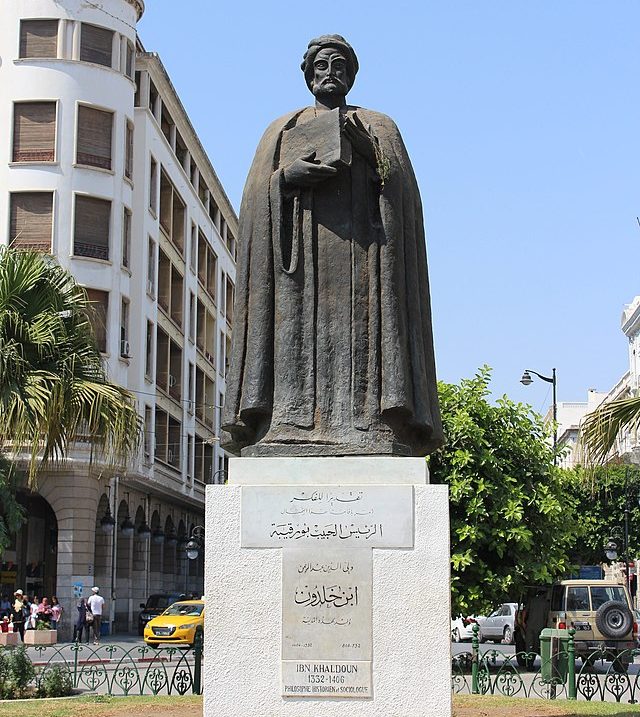
Statue of Ibn Khaldoun in downtown Tunis. Credits: Sami Mlouhi
In times of uncertainty, there is an almost instinctive reflex: to turn to the past in order to question the future. Our societies, shaken by political crises, economic collapses, and social dislocations, search for bearings amid the noise of the present. And it is then that certain ideas, centuries old, appear more lucid than contemporary diagnoses, more solid than the overheated debates of television studios. Ibn Khaldun belongs to that category of distant voices whose echo resonates strangely in our world. A man of the 14th century, living in a fractured Maghreb marked by wars of succession, famines, plagues, and identity retreats… a world that, in some respects, resembles ours more than we might like to admit.
Far from being a mere scholar confined to a dusty library, Ibn Khaldun was a politician, a diplomat, a direct witness to the violence of power, a survivor of the Black Death. His life, made up of flight, reversals, exile, and betrayal, reads like a novel. Yet it is precisely this turbulent existence that led him to forge one of the most audacious works in intellectual history: the Muqaddimah, the first attempt in human history to think scientifically about social life. A sociology before sociology, an anthropology before anthropology, a political economy before political economy. A work that resurfaces whenever the world begins to crack.
The paradox is that this medieval thought seems today more modern than ever.
A life between Empires, plagues, and intrigues
Imagine Tunis in 1332: a prosperous port city under the Hafsid dynasty, yet undermined by tensions that continue to intensify. It is here that Ibn Khaldun is born, into a learned family inheriting a long Andalusian tradition. His childhood is marked by study—grammar, law, logic, mathematics, theology. A classical education for a young man destined for a career as a scholar or civil servant. What was not planned, however, was that the world would collapse around him.
In 1348, the Black Death strikes Tunis. It claims his parents, his teachers, his loved ones. It devastates the cities of the Maghreb, just as it ravages Europe. This initial shock, this brutal encounter with human fragility, would echo throughout his work: societies are mortal, civilizations are fleeting, and the greatness of a state can sometimes hang by a thread.
From the moment he enters politics, Ibn Khaldun understands that public life is not a peaceful stage but a minefield. He serves the Marinids, the Berber dynasty that ruled Morocco from the 13th to the 15th century, in Fez, and finds himself caught in palace intrigues where loyalty is always suspect, where viziers fall as quickly as they rise. He is entrusted with important posts: secretary to the sovereign, head of the chancery, then qadi (a Muslim judge responsible for applying religious law—sharia—in civil, family, and sometimes commercial matters). But in this world, everything is provisional. A rumor, a jealousy, a military shift—and the man is disgraced, imprisoned, exiled.
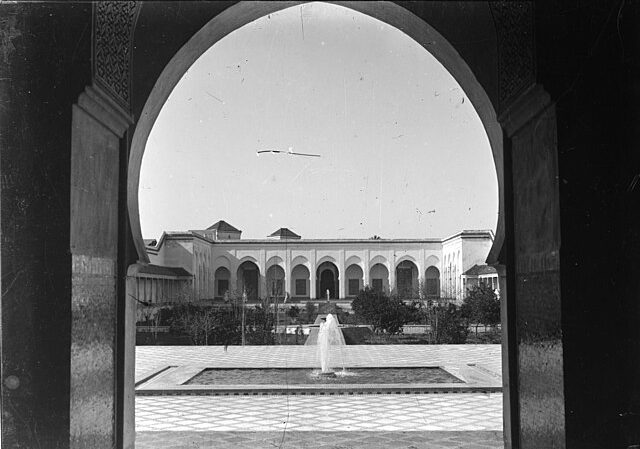
Fès Royal Palace, Morocco. Credits: Jean du Tailly
He flees to Granada, where the Nasrids welcome him as a prodigy. He meets the sultan, the famed Ibn al-Ahmar, and then the king of Castile, whom he seeks to persuade to sign a truce. He becomes a diplomat, an intermediary, a negotiator, crossing a war-torn Spain with an ease that seems almost unreal. But once again, politics catches up with him. The intrigue of a jealous adviser, a court quarrel, and Ibn Khaldun is forced to leave Granada in haste.
His existence resembles an accelerated apprenticeship in political life: nothing is stable, nothing is guaranteed, every power carries within it the seed of its own downfall. It is through these zigzags, these successive exiles, that he forges the conviction that dynasties do not die by chance, but through a deep, predictable, almost physiological mechanism.
The retreat he imposes on himself in the fortress of Beni Salama in 1375 marks a rupture. Three years of isolation. Three years spent contemplating the ruins of the world. Three years writing what would become his intellectual testament.
The Muqaddimah : An autopsy of a civilization in decline
The Muqaddimah is not just another book: it is an attempt to think about social life in its entirety. Where the historians of his time were content to recount events, Ibn Khaldun sought to understand the laws behind them. What holds a society together? What allows it to prosper? What destroys it?
At the heart of his reflection lies a concept: ʿasabiyya, often translated as solidarity, group spirit, or cohesion. For Ibn Khaldun, societies never emerge by chance. They are born from a cohesive group, often tribal, driven by a shared project, raw energy, and a form of organic solidarity. It is this vital, almost animal force that allows a group to conquer, to impose itself, to build a state.
But, according to Ibn Khaldun, this ʿasabiyya is not eternal. It wears out. It dissolves in comfort, luxury, and sedentarization. The more prosperous a society becomes, the more the bonds that once held it together loosen. Urban life weakens effort, tranquility dulls courage, administration replaces solidarity, the individual prevails over the collective. And it is here that his thought reveals a striking modernity.
Ibn Khaldun describes a dynamic familiar to all great powers: rise, apex, and decline. A dynasty is born from a courageous, disciplined, frugal elite. It settles in a city, builds an administrative apparatus, accumulates wealth. The next generation lives better; the one after, even better; the next, finally, lives too well. It loses the sense of effort, raises taxes to finance its lifestyle, exploits the population, provokes revolts, weakens itself. And then a new force emerges from the periphery, driven by a renewed ʿasabiyya, overthrowing the old order.
This is the theory of cycles: every civilization carries within it its own end.
It is hard not to see, in 2025, a mirror held up to Western societies: meteoric rise after 1945, comfort, growth, consumption, followed by a crisis of social bonds, political fragmentation, collapse of public trust, economic tensions, identity retreat. Ibn Khaldun almost seems, unwittingly, to offer a framework for reading our own anxieties.
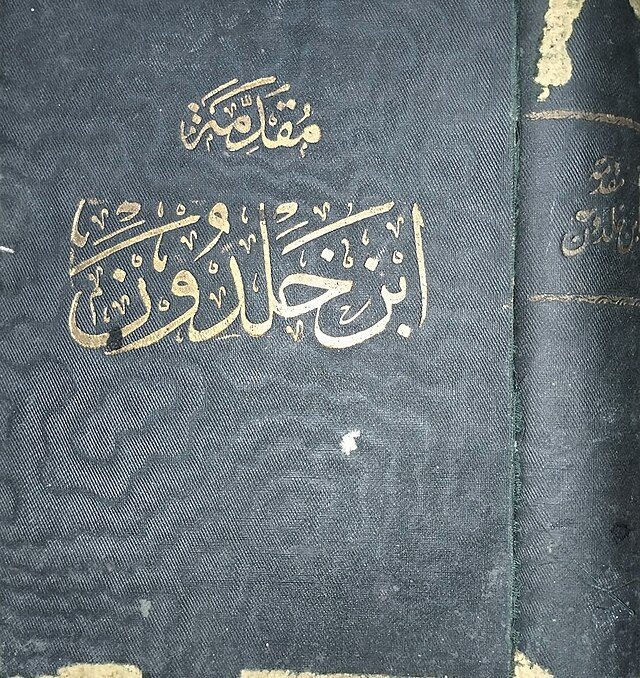
Muqaddima, Ibn Khaldoun. Credits: Riad Salih.
What does Ibn Khaldun tell us about today’s World?
This is perhaps where Khaldunian thought is most unsettling: it does not merely illuminate the past; it seems to diagnose our contemporary ailments.
Take Lebanon. The state is collapsing under the weight of hyperinflation, corruption, clientelist networks, and communal fragmentation. A broken ʿasabiyya, replaced by a mosaic of contradictory communal loyalties. Public services are shrinking, the productive economy is disappearing, elites are transferring their capital abroad, the youth are leaving the country. This is precisely the Khaldunian scenario of a society unraveling “through the softening of its own forces.”
Or consider Tunisia, Ibn Khaldun’s birthplace, shaken for over a decade by relentless political crises, by a state unable to collect taxes, by a highly educated youth with no prospects, by a fragmented political class incapable of restoring trust. Ibn Khaldun would explain it in a single sentence: when taxation no longer finances the future but merely serves to artificially sustain an elite, the state begins to die.
The lens can be widened further: the United States, plunged into historic polarization, where trust in institutions has reached record lows; France, where the social contract is fraying, where the middle classes feel abandoned, where anger is simmering; European democracies struggling to define a shared horizon.
Ibn Khaldun reminds us that it is not technological modernity that holds a society together, but the invisible bond that unites its members—the feeling of belonging to something greater than oneself. When that bond disappears, no amount of technology can replace it. He was not a sociologist, and yet he speaks of our time as if he had lived through it.
Lessons from a thinker for times of crisis
It would, of course, be futile to seek ready-made solutions to our contemporary crises in the Muqaddimah. Ibn Khaldun was not a prophet; he did not prescribe, he observed. But what he observes forces us to move beyond superficial discourse.
He first reminds us that no society is immune to decline. That power is never guaranteed. That even the most refined civilizations can collapse if they forget what gave them birth: solidarity, effort, justice, moderation. This is not a pessimistic message; on the contrary, it is a call for vigilance, political lucidity, and collective responsibility.
He also reminds us that the economy is not a mere mechanism, but a moral matter. When taxation becomes unjust, when elites hoard wealth, when productive classes are abandoned, when work ceases to be valued, a society begins to fracture. Economic crisis is never only economic: it is social, political, psychological.
Finally, Ibn Khaldun reminds us that living together is not a natural given, but a fragile construction requiring constant care. That cities, wealth, and growth can destroy faster than they build if they are not balanced by just institutions, a shared project, and a common vision of the future.
Perhaps this, ultimately, is the great lesson: a civilization does not endure by force, but by cohesion.
A voice from the 14th century for a disoriented World
Re-reading Ibn Khaldun in 2025 is not an exercise in erudition. It is a way of understanding what is universal about our crises. Political tensions, economic collapse, identity fractures, democratic fatigue, nationalist retrenchment are not accidents, but historical phenomena that other worlds have already experienced.
What Ibn Khaldun tells us, with almost unsettling clarity, is that the greatest danger is not the external enemy, but internal weakening. That societies collapse more often by their own hand than by assassination. That civilizations perish first through the slow erosion of their social cement, through the destruction of trust, through the abandonment of the common good.
His work is not a prophecy, but a compass. It invites us to look beyond elections, beyond budgets, beyond polemics, to question what, in our societies, still holds, and what is already beginning to crack.
It is striking that a man who lived in the 14th century, in a world ravaged by plague, war, and political disintegration, can illuminate our era with such acuity. Perhaps because, despite the centuries, human societies remain fundamentally the same: fragile, contradictory, capable of the best and the worst.
To understand Ibn Khaldun today is to understand that nothing is ever definitively acquired, neither freedom, nor prosperity, nor cohesion, nor even civil peace. It is to accept that every civilization must, in order to survive, rediscover what founds it: justice, effort, social bonds, trust. And it is perhaps, finally, to give ourselves the means not to repeat the same mistakes he saw emerging, all around him, seven centuries before us.
To go further:
Ibn Khaldun, The Muqaddimah: An Introduction to History, trad. Franz Rosenthal, Princeton University Press.
Gabriel Martinez-Gros, Ibn Khaldoun et les sept vies de l’islam, Actes Sud.
Gabriel Martinez-Gros, Ibn Khaldun et la théorie de l'État, Storiavoce. podcast link
Aziz Al-Azmeh, Ibn Khaldun in Modern Scholarship, Routledge.