The Egyptian state's relationship to spontaneous urbanization (2/2) : When the State builds the city, from land power to political authoritarianism
Al Mawja Contributor - 01/12/2025
"Formality and informality are fluid concepts that say more about the authority to legitimate certain practices than describe the condition of that particular practice." (Allen, 2016) [1].
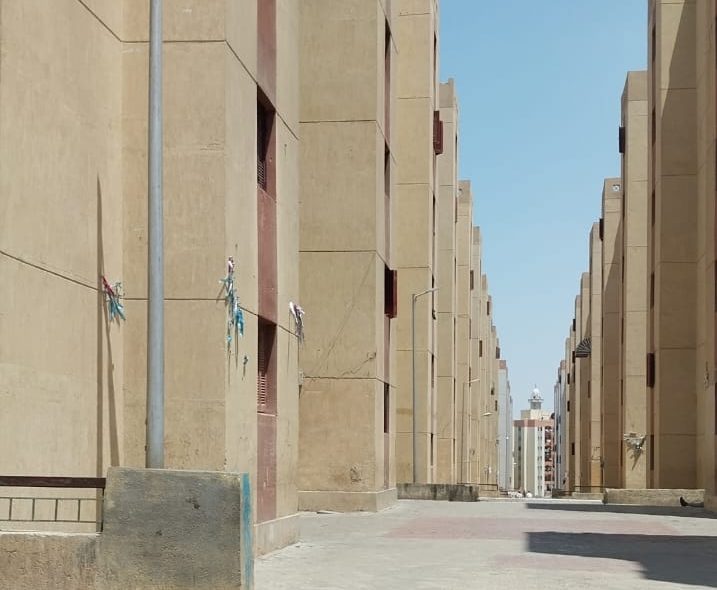
Al-Asmarat Complex, home to people evicted from numerous informal settlements in Greater Cairo. Credits : Al Mawja contributor
Although the economic role of the military wing of Egypt’s ruling class was already significant before the revolution, it has since acquired growing political influence, consolidating its dominance in capital accumulation while engaging with international financial institutions and global investors. At the time of the revolution, the army enjoyed strong ideological support—both for its role in national defence and its capacity to distribute food aid to millions of Egyptians. It succeeded in presenting itself as the saviour of the Nation, while other segments of the ruling class were discredited.
Mobilising an ideal of organic unity and natural harmony embedded in the Egyptian collective imagination, the new regime justifies a brutal repression of all opposition, accused of treason or of serving foreign interests seeking to destabilise the nation. The regime rekindles a form of Nasserism, though stripped of its social dimension. Through extensive turnover, military cadres have been propelled to the head of numerous governorates, ministries, and administrative agencies, particularly in the real-estate sector.
For example, the New Urban Communities Authority (NUCA)—a real-estate agency with extensive prerogatives over access to public land, its resale, and the granting of development rights—has been reshaped with numerous retired military officers [1]. Through the Armed Forces Projects Authority for Land (APFFO), the military extends its control over the commodification of state land, especially after a presidential decree authorised it to create joint ventures with private actors.
Operating through a neoliberal rationality in which land is governed by market logics, authorities establish increasingly porous relations with the private sector and reconfigure the state apparatus through public agencies whose functioning and mandates secure the ruling class’s tutelage. The transformation of the ISDF into the UDF embodies a structural shift: from a modest technical agency of sixty employees funded by state budgets (property taxes, NUCA surpluses), it has become an autonomous economic entity functioning as an investment fund beyond parliamentary oversight and standard auditing mechanisms. This metamorphosis forces former public agencies to self-finance through land valorisation, building “land banks” as collateral to access financial markets rather than mobilising fiscal resources for direct urban intervention.
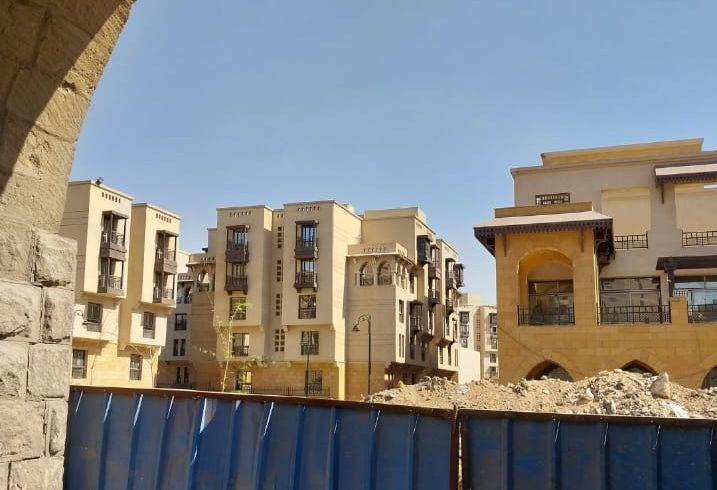
The construction of the Arabesque compound symbolises neoliberal property speculation in the heart of one of Cairo's historic neighbourhoods: by demolishing the working-class housing of al-Sukkar and al-Laymūn in the Sur Magra al-'Oyun neighbourhood, the state is replacing them with a luxury residential complex designed to attract private capital through a public-private partnership, under the guise of "heritage revitalisation”. Credits : Al Mawja contributor
The UDF’s operational dependence on the Armed Forces Engineering Authority—systematically appropriating 30 to 35% of project value—illustrates the army’s predation of urban production while weakening the state’s civilian capacities. Land expropriation no longer enriches the central state directly but serves as financial collateral, transforming territory into portfolios of investable assets through public–private partnerships.
This logic fundamentally departs from primitive accumulation: value no longer returns to the public treasury but to semi-autonomous funds (sunduq) and para-public entities tied to the military, operating through opaque off-budget channels. Urban evictions thus serve not only to transfer wealth, but also to make informal neighbourhoods bankable, turning them into attractive opportunities for credit markets and international investors. This raises questions about the broader financial architecture underpinning these domestic dynamics.
The Role of International Financial Institutions
International financial institutions interpreted the 2011 Arab uprisings as the consequence of weak governance structures, crony capitalism, and insufficient economic reforms [2]. The proposed solution has consistently been to expand the influence of the private sector and reduce the role of the state in the economy. For instance, the European Bank for Reconstruction and Development advocates boosting public–private partnerships in transport, energy, municipal services, and real estate. Similarly, the IMF pressures the Egyptian state to deploy a legislative framework conducive to private-sector growth.
When Sisi came to power, his priority was to restore Egypt as an attractive destination for investment. In 2014, he warned Egyptians of a period of painful austerity—seeking to reduce the deficit to below 10% of GDP—introducing severe cuts to public spending and social assistance. He increased taxes, launched large-scale privatisation campaigns, and implemented a “legislative revolution” redefining the state and its relations with private actors and citizens.
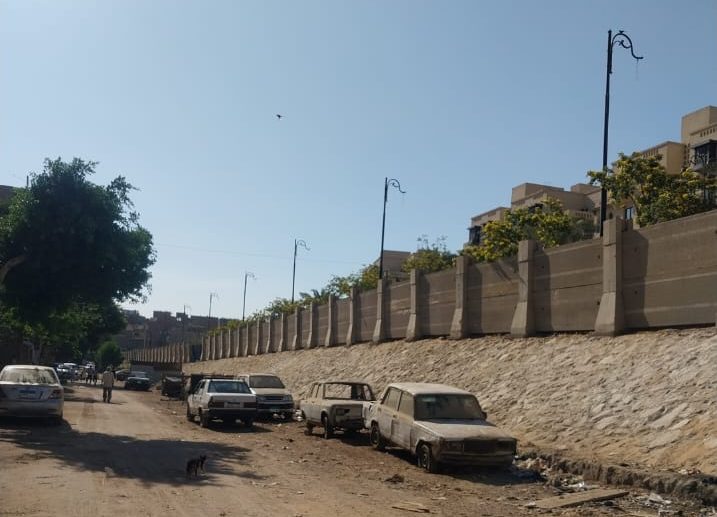
The 'Ayn al-Sira neighbourhood, adjacent to the future Arabesque compound. The spatial segmentation and security of the compound are achieved through thick, elevated walls. Credits : Al Mawja contributor
In his address to the Euromoney Egypt conference, he made his objectives explicit: stability, investment, growth—creating a competitive, attractive, predictable, free, and globalised business environment. It is within this international context that the authoritarian nature of the regime must be understood, as a constitutive element of its durability. Egypt’s structural dependence on foreign loans—exacerbated by an unfavourable geopolitical and energy context (Ukraine war destabilising food markets; Gulf economies shifting toward a post-oil era and reducing their financial support)—forced the regime to contract long-term loans with the IMF and, consequently, impose austerity measures. Deeply unpopular, these measures are nonetheless essential to creating a macro-economic environment favourable to external lending and foreign investment. It is only through the repression of civil society and all opposition that the regime has been able to enforce these policies and reinsert Egypt into global capital flows [3].
The regime’s authoritarian rationality is thus fundamentally intertwined with the structural financial constraints weighing on the country—constraints that fuel a repressive atmosphere produced and reproduced by an economic trajectory that further entrenches Egypt in patterns of foreign-loan dependency.
Accumulation by Dispossession and the Strategic Use of Informality
This is the context in which urban governance—and particularly the national plan to “Develop Informal Neighborhoods” (tatwiir al-ʿashwāʾiyyāt)—must be situated. The past decade has witnessed major demolition campaigns (Boulaq Abu al-‘Ila, Ayn al-Sirah, Batn al-Baqqara, Magra al-‘Uyun, Nazlet el-Semman…), justified by the stated aim of granting residents a “dignified life” (haya karima). Residents generally face two options: relocation to peripheral housing complexes (al-Asmarat, al-Mahrousa, Ahlya, al-Khialah), or financial compensation. These relocations create new forms of precarity: social ties are uprooted, and residents find themselves far from employment opportunities and from educational or healthcare services [4]. Meanwhile, compensation packages are far below the real market price per square metre [5].
Violent protests have erupted against these processes of accumulation by dispossession [6], as in the case of al-Warraq Island, where several waves of repression have been deployed to silence opposition to its transformation into a luxury financial and tourism hub—implying the mass eviction of inhabitants.
All these eviction operations are enabled by a legislative framework that facilitates arbitrary displacement, defined in sufficiently vague terms [7], as well as by the instrumentalisation of residents’ insecure land tenure in the absence of formal ownership deeds. This reveals how informality is used as a platform of power.
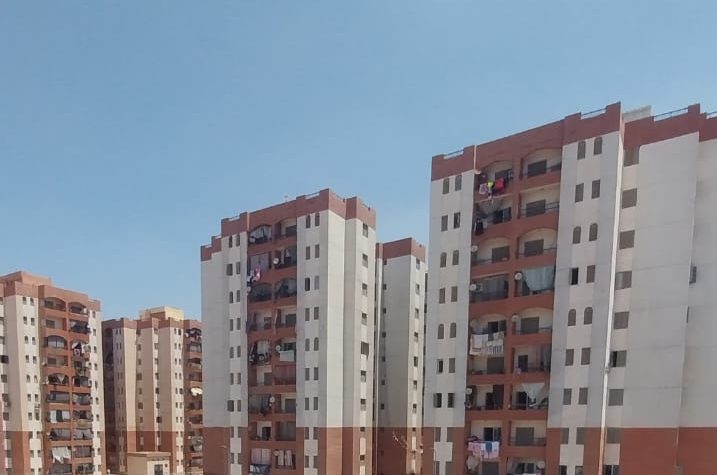
Al-Asmarat complex. Credits : Al Mawja contributor
Historical policies of neglect that long tolerated spontaneous urbanisation now permit authorities to exploit the legal grey zone that defines property rights in these neighbourhoods as a lever for expulsion and financialisation of residential space. Parallel to this, the “reconciliation” laws (tasaluh) aim to regularise property titles in some informal districts, but high application fees [8] and complex bureaucratic procedures reveal an extractive economic logic rather than a genuine urban-development policy fostering social integration.
Presidential decrees and ad hoc laws form a governance structure based on legal exception, in which technocratic rationales dissolve into ideological modernisation projects—the eradication of the ʿashwāʾiyyāt serving simultaneously as a mechanism of revenue extraction and symbolic assertion of authoritarian sovereignty.
The proliferation of autonomous funds signals the transformation of the state into military-financial networks escaping democratic accountability while deepening socio-spatial segregation and dependence on volatile global capital flows. This planning vision—along with the interventions stemming from it—rests on a representation of urban space as divisible, segmentable, homogenisable, commodifiable, and transformable into parcels assigned specific functions.
Informal housing undoubtedly suffers from numerous economic and infrastructural vulnerabilities; the aim here is not to romanticise this mode of shelter production or portray it as an absolute alternative. Yet the authorities’ approach to these neighbourhoods highlights processes of social engineering designed to make space legible in order to control it [9], and underscores the need to acknowledge the destruction of social solidarities which—while possessing their own complexities—nonetheless emerge from endogenous processes of formation and integration that are more just and sustainable in the long term for securing the right to the city.
[1] Joya, A. (2020). The military and the state in Egypt: class formation in the post-Arab uprisings. British Journal of Middle Eastern Studies, 47(5), 681-701.
[2] Joya, A. (2017). Neoliberalism, the state and economic policy outcomes in the post-Arab uprisings: The case of Egypt. Mediterranean Politics, 22(3), 339-361.
[3] Adly, A. (2021). Authoritarian restitution in bad economic times Egypt and the crisis of global neoliberalism. Geoforum, 124, 290-299.
[4] خليل, أمنية. “العدالة العمرانية وضبط الشعب.” Legal Agenda, March 25, 2024. https://legal-agenda.com/العدالة-العمرانية-وضبط-الشعب/.
[5] For example, as part of the Madinet Amal development, 232 homes in Ezzbet el-Hagganag were demolished. The residents were offered compensation of EGP 5,000 per square metre. By comparison, the new homes in the compound replacing their homes were put up for sale at prices ranging from EGP 2.6 million to EGP 3.5 million, or EGP 35,000 per square metre.
[6] Harvey, D. (2010). The right to the city: From capital surplus to accumulation by dispossession. In Accumulation by dispossession: Transformative cities in the new global order (pp. 17-32). SAGE Publications India Pvt Ltd..
[7] Alomran, Diwan. “Forced Eviction as an Instrument for the Restructuring of the Egyptian City.” ديوان العمران, September 1, 2025.
[8] Shawkat. “Egypt’s Updated Construction Violations Reconciliation Law: Development Analysis.” مرصد العمران, July 13, 2024. https://marsadomran.info/en/2024/07/3385/.
[9] Scott, J. C., & Ruchet, O. (2021). L'œil de l'État: moderniser, uniformiser, détruire. La découverte.