Israel, Palestine : two ballot boxes, one power
Victor Jardin - 27/10/2026.
On 27 October, 7.3 million Israelis are electing their Knesset in the first vote since 7 October 2023. A few kilometres away, some three million adult Palestinians in the West Bank, Gaza and East Jerusalem have no say in this vote, nor in their own, which has been postponed to 11 September 2027. Two ballot boxes, one power: a synthesis of our series "Two Ballot Boxes, One Mirror?".
By 10 a.m., turnout stood at 16.7%, against 15.9% at the same hour in 2022, according to the Central Elections Committee (Times of Israel). Long queues, complaints of torn-up ballot slips and mutual accusations of fraud show what is at stake. For part of the secular and liberal electorate, this is "the last chance to save Israeli democracy", as researcher Mairav Zonszein puts it (Al Jazeera).
On the other side of the Green Line, there are no queues. On 10 October, Mahmoud Abbas postponed the Palestinian legislative elections planned for 28 November, the first since 2006. Yet both societies are asking the same question: who governs them, and in whose name? And neither ballot box puts the occupation at the centre of the debate.
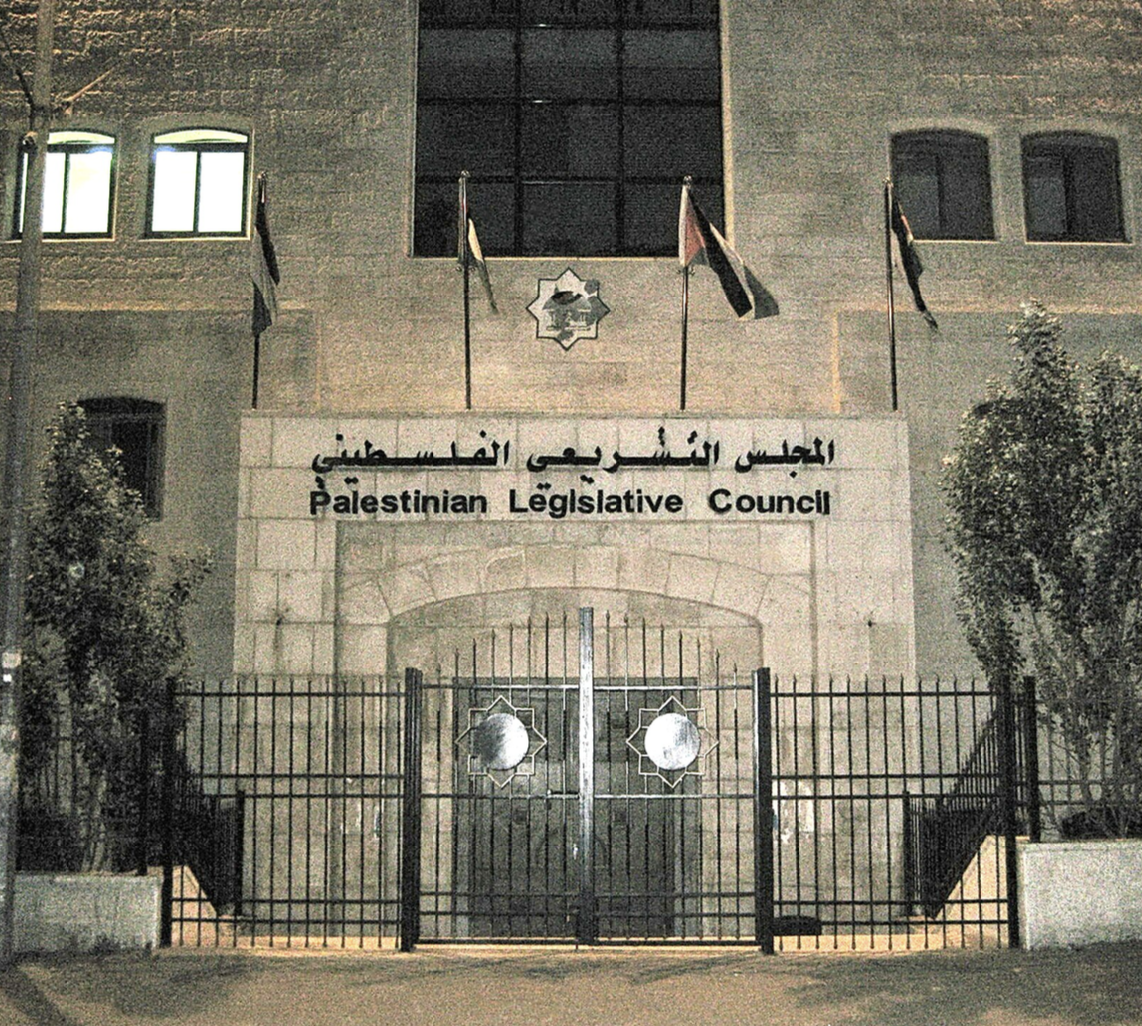
Le Conseil législatif palestinien à Ramallah. Élue en janvier 2006, l'assemblée n'a plus siégé comme parlement effectif depuis la scission de 2007. Les Palestiniens retournent aux urnes le 28 novembre 2026. (Photo : Magister, CC BY-SA 3.0, via Wikimedia Commons)
Israel : a referendum on October 7, not on occupation
The last polls, published on 23 October before the legal blackout, point to deadlock. Former army chief Gadi Eisenkot's Yashar party leads Benjamin Netanyahu's Likud: 23 seats to 21 according to Channel 12, 22 to 20 according to Kan. But neither bloc reaches the 61 seats needed. The change bloc is credited with 52 to 56 seats, the outgoing coalition with 50, and the Arab lists with 14 to 16 (Times of Israel).
The key to the arithmetic therefore lies with Israel's Palestinian citizens, some 1.2 million voters. Yet both blocs have ruled out governing with their parties for now (Al Jazeera). The Central Elections Committee, where the coalition holds a majority, had even voted to bar the Joint List and Ra'am, before the Supreme Court overturned the decision. Without them, the opposition cannot govern. With them, it loses part of its electorate. "If the opposition falls short of 61 seats, the deadlock itself becomes Netanyahu's latest win," notes Joseph Mansour, a former aide to MK Ayman Odeh. Without a coalition, Israelis would return to the polls in early 2027, with Netanyahu as caretaker prime minister.
The campaign turned on accountability for 7 October, military exemptions for the ultra-Orthodox and the judicial overhaul. The Palestinian question is not on the ballot, or rather, it appears there only as a consensus. Eisenkot says he is "absolutely opposed" to any Palestinian state in the near or medium term (Jerusalem Post). On the right, Bezalel Smotrich proposes annexing 82% of the West Bank (Times of Israel), and in late September called for doing "in the West Bank what we did in Gaza" (Al Jazeera). The choice offered to voters is not peace versus war. It is open annexation versus a better-managed occupation.
Palestine : a postponed vote and three locks
The 10 October decree merges the legislative elections with the presidential vote, now set for 11 September 2027. The PLO Executive Committee blames Israel: election materials and observers blocked at Gaza's gates, raids and settler violence in the West Bank, tax revenues withheld (Al Jazeera). These obstacles are real. Israeli Foreign Minister Gideon Saar nonetheless accuses Abbas of "fooling the international community".
The two narratives complement each other more than they clash. The first lock is the occupation. The second is Fatah itself. According to an AFP source, the factions, Fatah included, had agreed on a prior "national dialogue" and wanted the vote postponed. Fatah no longer really fears Hamas, which has fallen to 29% of voting intentions against its own 32% (PCPSR). It fears its own ranks: Marwan Barghouti, imprisoned in Israel, and Mohammed Dahlan, expelled in 2011, who is demanding the reinstatement of his supporters. Back in 2021, Abbas had already cancelled a vote in the name of East Jerusalem.
The third lock lies in the conditions set for Hamas. The document Abbas put on the table in Cairo demands recognition of the PLO as the "sole legitimate representative" and "one legitimate armed force". Hamas accepts the first demand, but not the PLO's commitments, including recognition of Israel and security coordination (Asharq Al-Awsat). One detail sums up the moment: intra-Palestinian talks will resume only after the Israeli vote. "Everything is concentrated in the hands of the executive," laments Mustafa Barghouti, secretary-general of the Palestinian National Initiative.

Siège de la Knesset, le Parlement israélien. Wikimedia Commons, 2022.
Who governs Palestine ? Powers without mandate
In Ramallah, Mahmoud Abbas, 90, holds three posts: president of the Palestinian Authority, chairman of the PLO and leader of Fatah. Elected in 2005, he has ruled by decree since his term expired in 2009. His succession is being arranged without ballots. Hussein al-Sheikh, long in charge of relations with Israel, is PLO vice-chairman, designated to serve as interim president in case of vacancy, and Fatah's number two (Anadolu). Yet the party congress in May sent a different signal: Marwan Barghouti, detained since 2002, won the most votes (The National). The apparatus picks the heir; the base picks the prisoner.
In Gaza, fragmentation runs deeper still. On 6 July, Hamas dissolved its emergency committee, which had run the enclave since October 2023, and said it was handing its powers to the National Committee for the Administration of Gaza. This committee of fifteen unelected technocrats, chaired by Ali Shaath, reports to Donald Trump's Board of Peace, on which no Palestinian sits. Its members have never been able to enter Gaza, for lack of Israeli approval (Arab Center Washington DC). Hamas, for its part, has neither a government nor any intention of disarming as long as the Israeli army remains.
Then there is the power least often named. The Israeli army alone controls 60% of the West Bank, the Area C inherited from Oslo, and about 58% of Gaza, east of the "yellow line" (Al Jazeera). In Palestine, everyone seeks legitimacy somewhere other than the ballot box: in the apparatus, in prison or in arms. And the one actor whose decisions bind everyone answers to no Palestinian voter.
Societies : politics without representatives
On the Palestinian side, the latest poll by the Palestinian Center for Policy and Survey Research (PCPSR), conducted from 5 to 8 August among 1,270 people, belies the idea of a resigned society (PCPSR). 79% of Palestinians want Abbas to resign, and 65% see the Authority as "a burden". Yet 54% wanted to vote, even if Israel blocked polling in East Jerusalem. In a presidential race, Barghouti would win with 54% of the vote, ahead of Khalil al-Hayya (26%) and Abbas (14%).
Two trends deserve attention. First, support for negotiations has risen to 44%, from 36% in the previous survey, while support for armed struggle has fallen from 41% to 27%. But 72% reject Hamas disarming before an Israeli withdrawal: war-weariness is not surrender. Second, Palestinians expect nothing from the Israeli vote. If Netanyahu lost, 34% think nothing would change, 33% that things would get worse, and only 28% hope for improvement.
In Israel, the newest social signal comes from Palestinian citizens. Polls put their likely turnout at around 60%, and campaigners are aiming for 70%, which would be the highest in decades (Al Jazeera). On polling day, Bezalel Smotrich was already attributing the high turnout to the Arab vote, though official figures do not allow this to be verified (Times of Israel). Excluded from coalitions, they remain the one electorate able to tip the vote.

Manifestations à Jérusalem en opposition à la réforme du système judiciaire voulue par Netanyahu, le 12 février 2023, Wikimedia Commons.
The mirror
The two ballot boxes are not alike. One works, under the strain of a democracy worried about itself. The other has stood empty for twenty years. Yet they reflect the same image: power decided without those who bear its consequences. In Israel, the prime minister can change without the West Bank entering the campaign. In Palestine, the heir apparent can change without a single voter being consulted.
Whatever tonight's result, the Palestinian agenda remains suspended on Israel's: the resumption of the Cairo dialogue, the technocratic committee's entry into Gaza, the fate of Marwan Barghouti. A change of government in Jerusalem would probably change the tone. Nothing in the platforms suggests it would change the rule: those who live under occupation still have no ballot box with which to contest it.
Sources
- Times of Israel, liveblog du 27 octobre 2026
- Times of Israel, derniers sondages avant le scrutin (24/10/2026)
- Al Jazeera, « Israel's election: Five key things to know » (26/10/2026)
- Jerusalem Post, positions de Gadi Eisenkot (03/09/2026)
- Times of Israel, plan d'annexion de Smotrich (03/09/2025)
- Al Jazeera, Smotrich appelle à la guerre en Cisjordanie (27/09/2026)
- Al Jazeera, report des élections palestiniennes (10/10/2026)
- Asharq Al-Awsat, les pourparlers Fatah-Hamas au Caire (22/10/2026)
- PCPSR, sondage n° 97 (5-8 août 2026)
- Anadolu, Hussein al-Sheikh vice-président du Fatah
- The National, Barghouti en tête au congrès du Fatah (18/05/2026)
- Arab Center Washington DC, la dissolution du gouvernement du Hamas (15/07/2026)