Democracy under supervision: Bourguiba, Ben Ali, and Tunisia’s authoritarian legacy - 2/3
François Theri - 13/07/2026.
On November 7, 1987, Tunisians woke up in a country that had changed presidents overnight. A few hours earlier, a group of doctors had signed a certificate declaring Habib Bourguiba unfit to carry out his duties. The father of independence, national hero, and president for more than thirty years, the “Supreme Combatant” was removed from power without confrontation or popular mobilization. His Prime Minister, Zine el-Abidine Ben Ali, was sworn in immediately afterward. Officially, the Constitution had been respected. In reality, Tunisia entered a new phase of its political history.
For a long time, Ben Ali appeared to be the man of change. He promised political openness, an end to the presidency for life, and the modernization of state institutions. Abroad, he was seen as a pragmatic leader capable of combining political stability with economic development. Yet behind this reformist façade, a system gradually emerged that was even more tightly controlled than the one inherited from Bourguiba.
As the years passed, the new president concentrated power, neutralized the opposition, expanded state control over society, and allowed a vast system of economic privileges to develop around him. The regime built its legitimacy on the promise of order, but this stability rested above all on surveillance, repression, and the absence of any credible political alternative.
This reality also sheds light on contemporary Tunisia. When Kaïs Saïed suspended Parliament in July 2021 and gradually concentrated power in his own hands, reactions remained limited. Part of the population appeared more concerned with the economic crisis than with the disappearance of institutional checks and balances. This relative silence recalls another moment in Tunisian history: the period when Ben Ali consolidated power without encountering any genuine resistance.
Far from breaking with Tunisia’s authoritarian tradition, the regime established after 1987 refined many of its mechanisms. Behind the image of a modern and efficient state lay a system built on three pillars: political control, economic capture, and the ideological supervision of society.
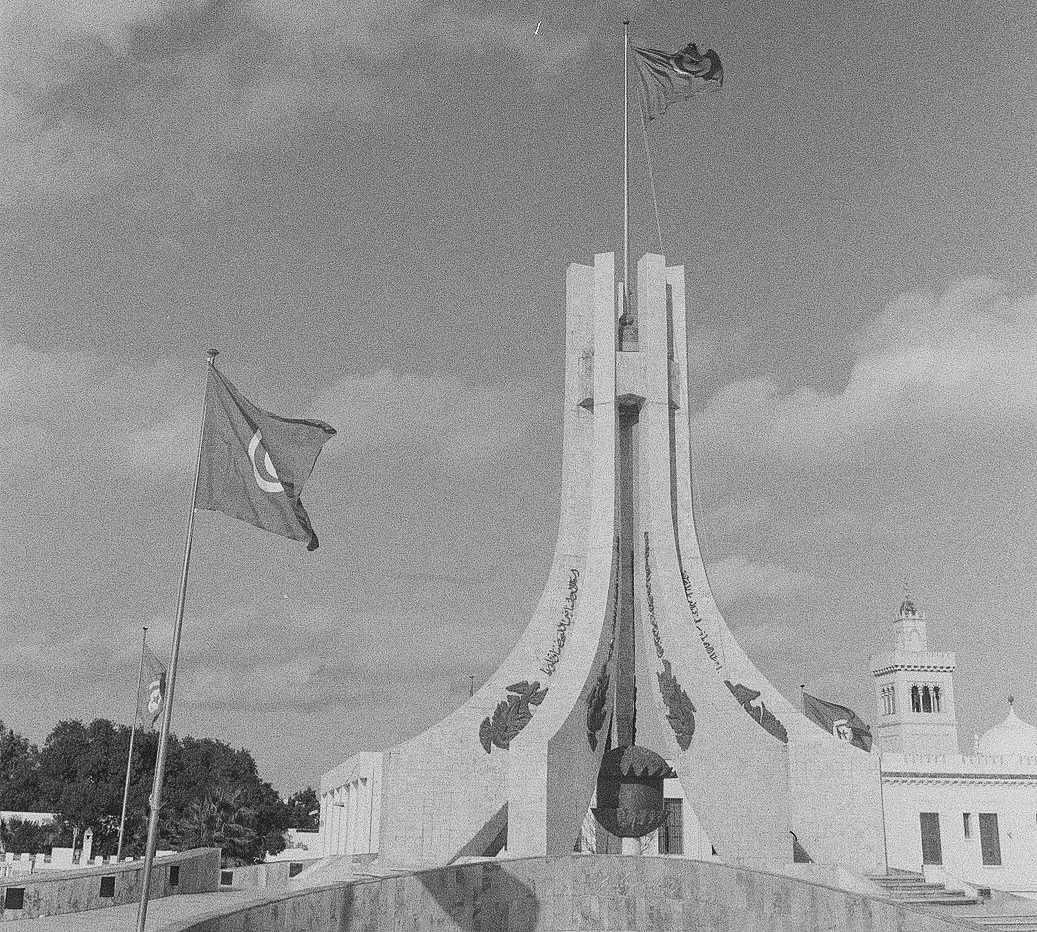
Kasbah, National monument, Tunis. Crédits: Martin Amrouche.
November 7 : The birth of a new presidential cult
The change was first reflected in symbols. Bourguiba’s portraits gradually disappeared from public places. National commemorations changed. November 7 became the country’s new founding date. Like his predecessor before him, Ben Ali sought to place his own name at the center of the national narrative. The new president preserved Bourguiba’s modernizing legacy while adopting and perfecting the authoritarian mechanisms that had structured independent Tunisia. He concentrated power, as the regime revolved around an omnipresent presidency, a cult of personality, and a dominant party that absorbed almost all political life.
The only event that punctuated political life was November 7, marked by carefully staged displays of loyalty and by the fact that the presidency became “the epicenter of all public life.” In 2007, on the twentieth anniversary of the “Change,” the official press still celebrated the “valiant son of Tunisia” who had supposedly saved the country from chaos. The narrative was now firmly established: before Ben Ali, instability; after Ben Ali, order and prosperity. Beyond a mere seizure of power, Ben Ali’s rise, like Bourguiba’s before him, involved erasing everything that had come before. Before the new leader, nothing had meaning; there was only chaos, which the new leader came to repair.
The Ben Ali system completely locked down Tunisia’s political apparatus. Opposition political parties were monitored, weakened, or prevented from playing any meaningful role. As a result, political space remained under permanent constraint, with no legal avenue for dissent. Opposition parties had no legal existence, and public gatherings were prohibited under penalty of imprisonment for political activists. Political organizations and students were unable to express themselves freely and remained under constant surveillance: “The President’s party, the Democratic Constitutional Rally (RCD), together with neighborhood committees covering the territory in both urban and rural areas, maintained constant vigilance over public spaces and sensitive groups (young people, the unemployed, former Islamists, etc.). The media, cybercafés, Internet websites, and the press were all controlled by the State.” Finally, it was the populations suffering most from economic exclusion that became the primary focus of the Ben Ali regime’s surveillance apparatus.
Thus, political life in Tunisia revolved around a single ruling party with no genuine opposition, a situation that had already been tolerated under Bourguiba, the Father of the Nation. Western countries, in turn, tolerated the establishment of this dictatorship because the Ben Ali regime displayed exemplary economic performance.
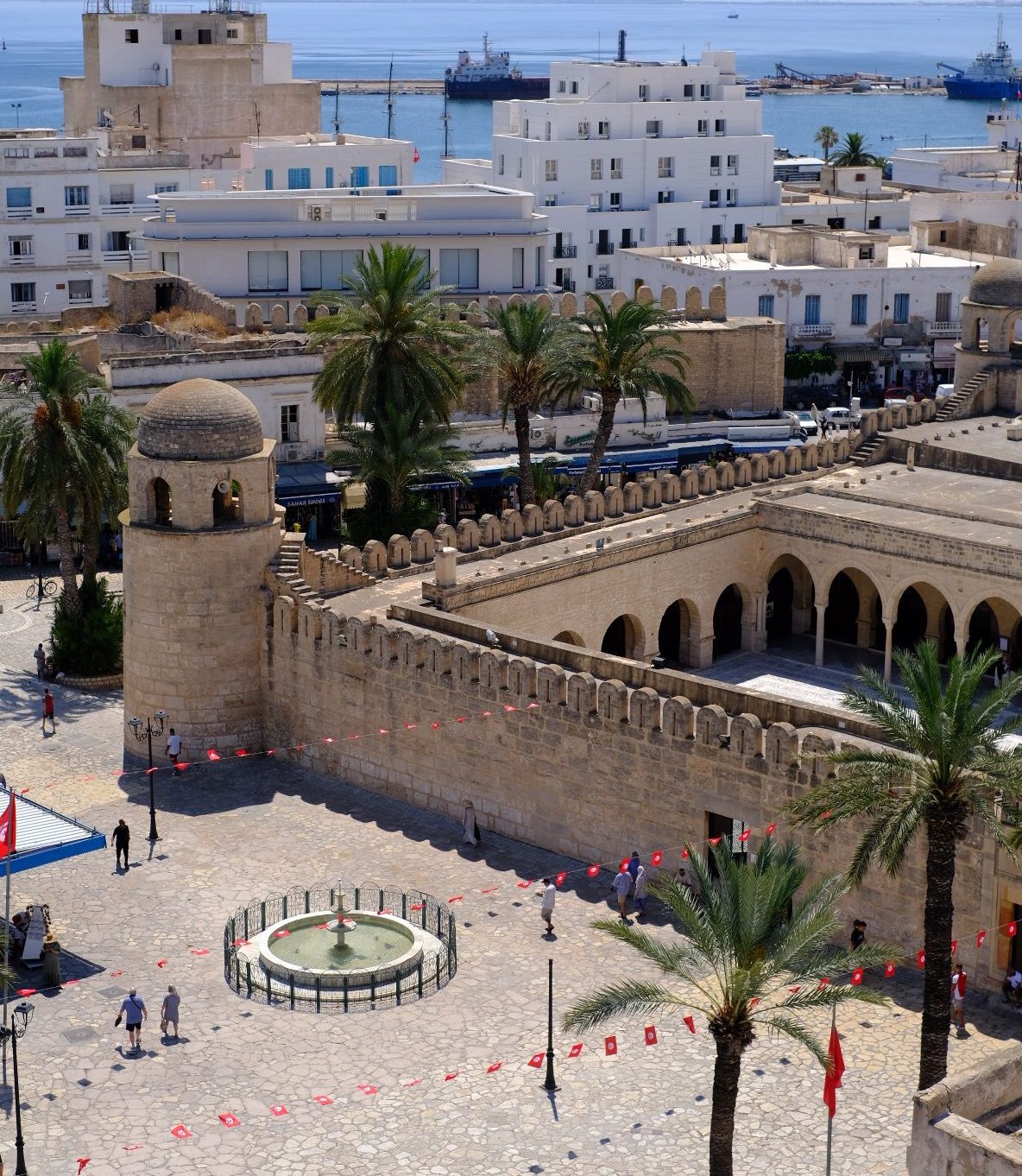
The Great Mosque in Sousse. Credits : Habibis on wheels / @habibisonwheels
A system of corruption and economic clientelism
Throughout the 1990s and 2000s, the regime no longer limited itself to controlling politics. It also extended its influence over the economy. Around the president, a circle of families and business figures gradually emerged whose success largely depended on their proximity to those in power.
The enrichment of the presidential clan did not appear to stem from a conventional entrepreneurial logic, but rather from a range of mechanisms of institutional predation: controversial privatizations, opaque allocations of public contracts, acquisitions of assets at negligible prices, and control over particularly profitable sectors. This dynamic reached its peak with the rise of the Trabelsi family, drawn from the entourage of Leïla Ben Ali. In Tunisian public opinion, the Trabelsi name gradually became synonymous with privilege, favoritism, and rapid enrichment.
The most emblematic financial affairs primarily concerned the banking sector. Several operations are regularly cited, notably the takeover of Banque de Tunisie and BIAT, the creation of new banking institutions such as Banque Zitouna, and the controversial sale of Banque du Sud, described as having benefited networks close to the regime through insider transactions. The telecommunications sector and major strategic companies were not exempt from this dynamic, with frequent references to Ooredoo Tunisia, Orange Tunisia, Tunisair, and Carthage Cement. The automotive sector provides another example frequently cited to illustrate this concentration of economic power. The privatization of Ennakl Automobiles, the takeover of distribution companies such as Le Moteur (Mercedes/Fiat), the granting of the Peugeot license to STAFIM, and the control of the Ford, Range Rover, Jaguar, Hyundai, and KIA brands were reportedly entrusted to individuals close to the president. The Tunisian media also appeared to be a sector heavily shaped by political co-optation. Several radio stations and television channels, including Mosaique FM, Chams FM, Zitouna FM, Jawhara FM, Express FM, Carthage TV, and Hannibal TV, reportedly benefited personalities closely connected to the regime.
Real estate and land ownership constituted another major aspect of this economic capture. Numerous plots located in the most valuable areas of Tunis’s northern suburbs (particularly Sidi Bou Saïd, Gammarth, Carthage, and La Goulette), as well as land belonging to STEG and SONEDE, were reportedly allocated to or placed under the management of individuals close to the regime, particularly members of the Trabelsi family, the president’s in-laws. This policy of redistributing public assets reportedly reinforced a process of privatization for the benefit of the ruling family’s inner circle.
The scale of the phenomenon is also highlighted by several figures presented in the 2022 report of the French Office for the Protection of Refugees and Stateless Persons. The report refers to an estimated fortune of €522 billion attributed to Ben Ali and €12 billion to the Trabelsi clan. Following the 2011 revolution, the Tunisian authorities reportedly confiscated assets belonging to 112 relatives and associates of the regime. As early as July 2011, 30 members of the clan were brought before the courts, while Ben Ali faced 93 criminal charges, resulting in cumulative prison sentences totaling 195 years. As of October 2021, judicial proceedings still recorded 27 convictions and 6 acquittals. The Ben Ali regime appears as a system of political rent-seeking in which access to power provided access to economic assets, licenses, monopolies, and public contracts, while an ever-growing share of the population lived in precarious conditions. The regime gradually lost credibility in the eyes of Tunisians who, lacking connections to those in power, were unable to integrate into the formal economy and instead found themselves relying on informal survival strategies, facing high unemployment within a context of social exclusion and institutional lock-in. This dynamic progressively weakened the state, discouraged competition, and fueled the social resentment that helps explain the scale of the 2011 Tunisian Revolution.
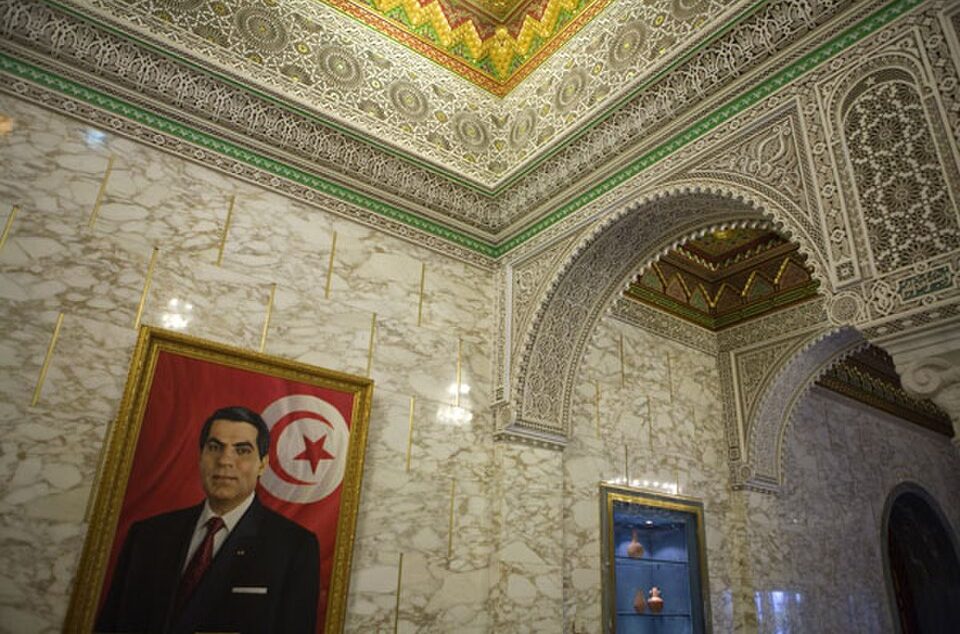
Portrait de Zine el-Abidine Ben Ali dans le palais présidentiel de Carthage, crédits: Wikimedia commons.
Media, social, and ideological control
Controlling information also became one of the regime’s priorities. It was not merely an authoritarian government in the institutional sense, but a system that sought to prevent any public criticism by tightly controlling channels of expression. During the 2000s, Tunisians lived in a media environment under close surveillance. Critical newspapers were marginalized, the Internet was filtered, and cybercafés were subject to particularly close monitoring by the authorities. Vincent Geisser shows that media outlets close to the regime participated in the constant glorification of the president and the dissemination of official propaganda, transforming information into an instrument of political legitimation rather than a space for pluralism.
This control did not stop at state institutions or the media. It extended throughout society through the territorial network established by the RCD, neighborhood committees, and various local monitoring mechanisms, enabling the regime to supervise everyday behavior and social interactions. The authorities therefore did not merely repress already organized opponents; they also sought to prevent any form of collective mobilization before it could even become openly political. This logic of social supervision reinforced the perception of a closed public sphere, where the circulation of ideas, people, and initiatives remained subject to constant surveillance.
Under Ben Ali, the religious sphere was incorporated into a highly centralized state logic: Islam was not left to an autonomous authority but administered by the government, which controlled mosques, imams, sermons, and even institutions responsible for religious education. Franck Frégosi clearly demonstrates that the Tunisian state established a genuine administration of religious affairs through the appointment and training of religious officials, the supervision of mosques, and the monitoring of religious activities. This organization enabled the regime to transform religion into a political resource rather than a countervailing power. This policy also assumed an ideological dimension. Frégosi explains that the authorities sought to promote a “national Islam,” modernized and compatible with official discourse, notably through the promotion of a moderate Islam and the staging of a state religion serving political stability. Ben Ali did not merely fight political opponents; he also fought any religious authority capable of escaping state control.
It is also in this context that the confrontation between Ben Ali and Ennahda must be understood. Ennahda is a Tunisian political party inspired by Islamic conservatism that played a central role in the country’s democratic transition after 2011. The rise of Islamist opposition led the Tunisian state to tighten its control over religious affairs, particularly from the late 1970s onward and, above all, in the early 1990s, when the break between the authorities and the Islamists became complete. In the eyes of the regime, Ennahda was not simply another opposition movement. It challenged the monopoly that the state sought to exercise over religion, but also over the very definition of Tunisian identity. After its creation in 1981, the movement was quickly targeted by mass arrests, Rached Ghannouchi was sentenced to prison, and many of the party’s leaders were forced into exile or underground activity.
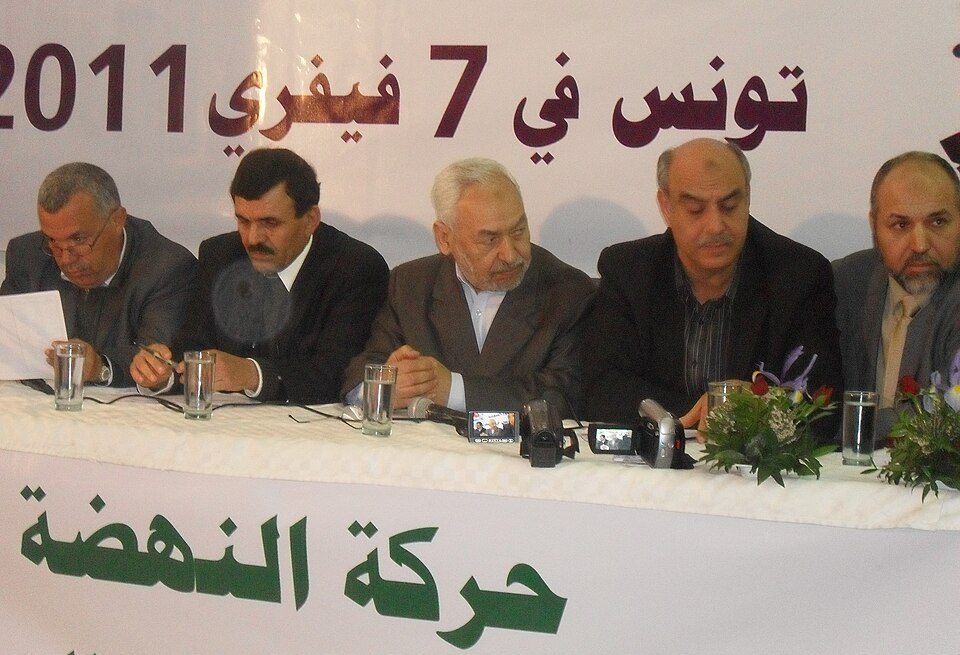
First Ennahda press conference after their comeback in Tunisia in 2011. Crédits: Wikimedia Commons.
The repression of Ennahda therefore reveals the regime’s underlying logic: it was not simply a matter of neutralizing a political opposition, but of preventing an autonomous political Islam from competing with the legitimacy of the state. What emerges is a process of religious control and the sacralization of political power, accompanied by the construction of the administrative architecture that made such control possible. In practice, the Tunisian state under Ben Ali tolerated a tightly supervised Islam while repressing any organized Islamic movement that sought to intervene in the political sphere, such as the Ennahda party.
For more than twenty years, Ben Ali projected the image of a stable, modernized, and relatively prosperous Tunisia to his Western partners. Behind this façade, however, a regime based on surveillance, political repression, and the capture of wealth by a narrow ruling circle was taking shape. When unrest erupted in Sidi Bouzid at the end of 2010, it was not directed solely against unemployment or the rising cost of living. It expressed the rejection of a system that had gradually suffocated every avenue for dissent. Within a matter of weeks, what had appeared to be one of the Arab world’s most stable regimes collapsed. Yet Tunisia’s history demonstrates that the fall of one man does not necessarily mean the disappearance of the authoritarian reflexes that have structured the state since independence.