Democracy under supervision: Bourguiba, Ben Ali, and Tunisia’s authoritarian legacy - 3/3
François Theri - 14/09/2026.
Fifteen years after Ben Ali’s fall, what remains of Tunisia’s revolution? Between democratic aspirations, constitutional compromise and social disillusionment, the transition launched in 2011 never fully broke with the country’s authoritarian legacy. From the enthusiasm of the first free elections to the return of a presidential system centered around Kais Saied, Tunisia has experienced a decade of profound transformations, but also deep political and institutional deadlocks. Why did pluralism fail to deliver on the demands for dignity, social justice and freedom that had driven the revolution? A look back at an unfinished democratic transition whose shortcomings help shed light on the country’s current political trajectory.
On January 14, 2011, the flight of Zine el-Abidine Ben Ali appeared to open an unprecedented historical chapter in Tunisia. For the first time since independence, the political order built around a centralized presidential power was shaken by a popular mobilization that emerged from the country’s social and territorial margins. Very quickly, the event was interpreted by the international press as a major rupture: the fall of the authoritarian regime would usher Tunisia into an era of democratic transition, popular sovereignty, and political pluralism.
This political moment raises a series of questions that remain unanswered today: What political system? For what nation? What political orientations? It is this linear interpretation of an unfinished revolution that deserves to be questioned. The Tunisian revolution did not emerge in a political vacuum; it took shape within a state deeply marked by the Bourguibist legacy, consolidated and then hardened under Ben Ali, in which the centralization of power, the personalization of authority, and the weakness of checks and balances had long structured relations between the state and society.
The question, therefore, is less how Tunisia became democratic after 2011 than what this transition actually transformed within a system shaped by decades of authoritarian rule. The significance of the Tunisian moment lies precisely in this ambivalence. On the one hand, the period opened by the revolution saw the emergence of free elections, a Constituent Assembly, a pluralist Constitution in 2014, and unprecedented forms of political participation; on the other, it remained marked by social inequalities, institutional deadlock, partisan conflicts, and the persistence of a strong demand for state order. Tunisia’s democratic transition thus appears less as a break with authoritarianism than as an unstable experiment, marked by the persistence of the authoritarian syndrome and the search for a strong figure.
This article continues a broader reflection on the longue durée of the Tunisian state. After examining how Bourguiba established an authoritarian form of modernism and how Ben Ali perfected a system of political, economic, and social control, the aim here is to examine the period opened in 2011: its promises, achievements, but also the limitations that progressively weakened Tunisia’s democratic experience.
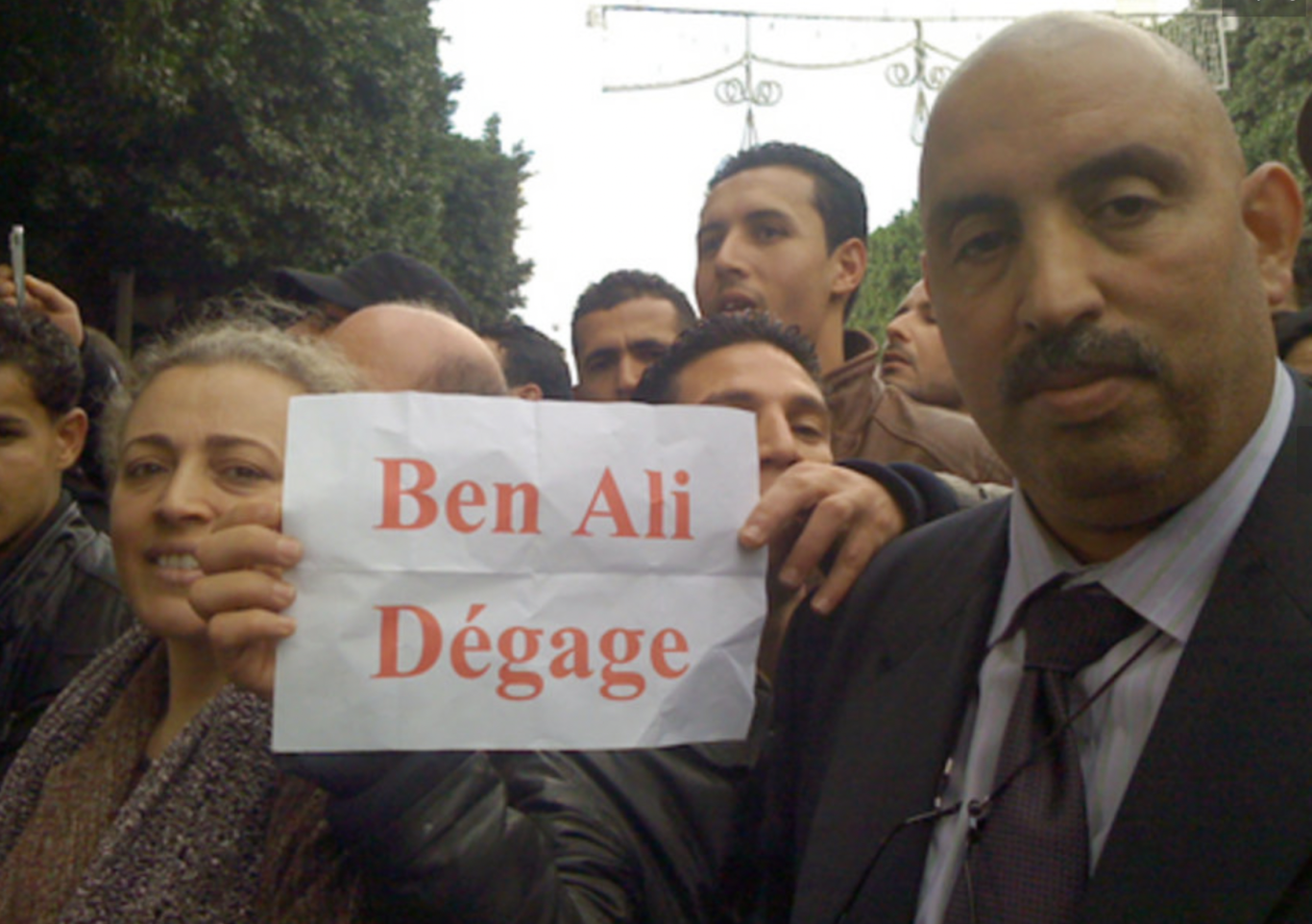
Unrest culminates all over Tunis with one clear message from protesters of all ages: President Ben Ali must leave. Crédits : Wikimedia commons, 14 janvier 2011
A political rupture built around demands for dignity, freedom and social justice
The 2011 revolution emerged from a combination of several factors. Political repression, social humiliation, and territorial inequalities were the starting points of the protest movements in Tunisia. While they led to the fall of the regime in less than a month, they revealed a desire for profound social change without allowing time for the reconstruction of a national identity.
The protests began in Sidi Bouzid, in the center of the country, on December 17, 2010, following the self-immolation of Mohamed Bouazizi, a victim of a corrupt police force and a symptom of a broader demand for social assistance. Ben Ali’s police state, characterized by both the personalization and centralization of the state apparatus, drove the population to demonstrate against political power, corruption, and the very clear conflation of the state apparatus with the interests of the ruling clan. The fact that the demonstrations began in the country’s interior, in territories lacking economic activity, was a central driving force of the Tunisian revolution.
Territorial divides were also decisive: according to Jaldi and Akrimi, metropolitan Tunisia concentrated 87% of industrial activity and more than 90% of tourism activity, which helps explain the importance of the country’s interior regions in the revolutionary protests. Economic activity was monopolized by a clan-based political system, that of the Trabelsi family, which built an economic apparatus benefiting only a small minority. The research conducted by Aziz Nachi documents this reality: approximately 10% of the population controlled more than one-third of GDP, while around 30% of the population had to make do with less than 1% of GDP; unemployment affected between 15% and 20% of the population. These were the demands at the heart of Tunisian protest slogans: “Freedom, work and dignity.” Tunisia then entered an unprecedented situation, in which no political figure was able to establish genuine authority, while Tunisians called for political consensus in order to determine the appropriate political system, all within a very short period of time.
The 2011 revolution brought new names to the fore, this time associated with popular mobilization and the transition. Mohamed Bouazizi became the symbolic figure of the population’s uprising against its tyrant. Around him, young people, trade unionists, human rights activists, and residents of the interior regions carried a movement based on dignity, employment, and freedom. Among the political actors of the post-revolution period, Rached Ghannouchi and the Ennahdha movement, meaning “Renaissance,” played a central role, as did Béji Caïd Essebsi, who structured much of the modernist and anti-Islamist camp. Moncef Marzouki, for his part, embodied a transitional figure and an advocate of human rights. These political leaders gave a voice to different popular aspirations in the post-revolution period, with radically different institutional transitions.
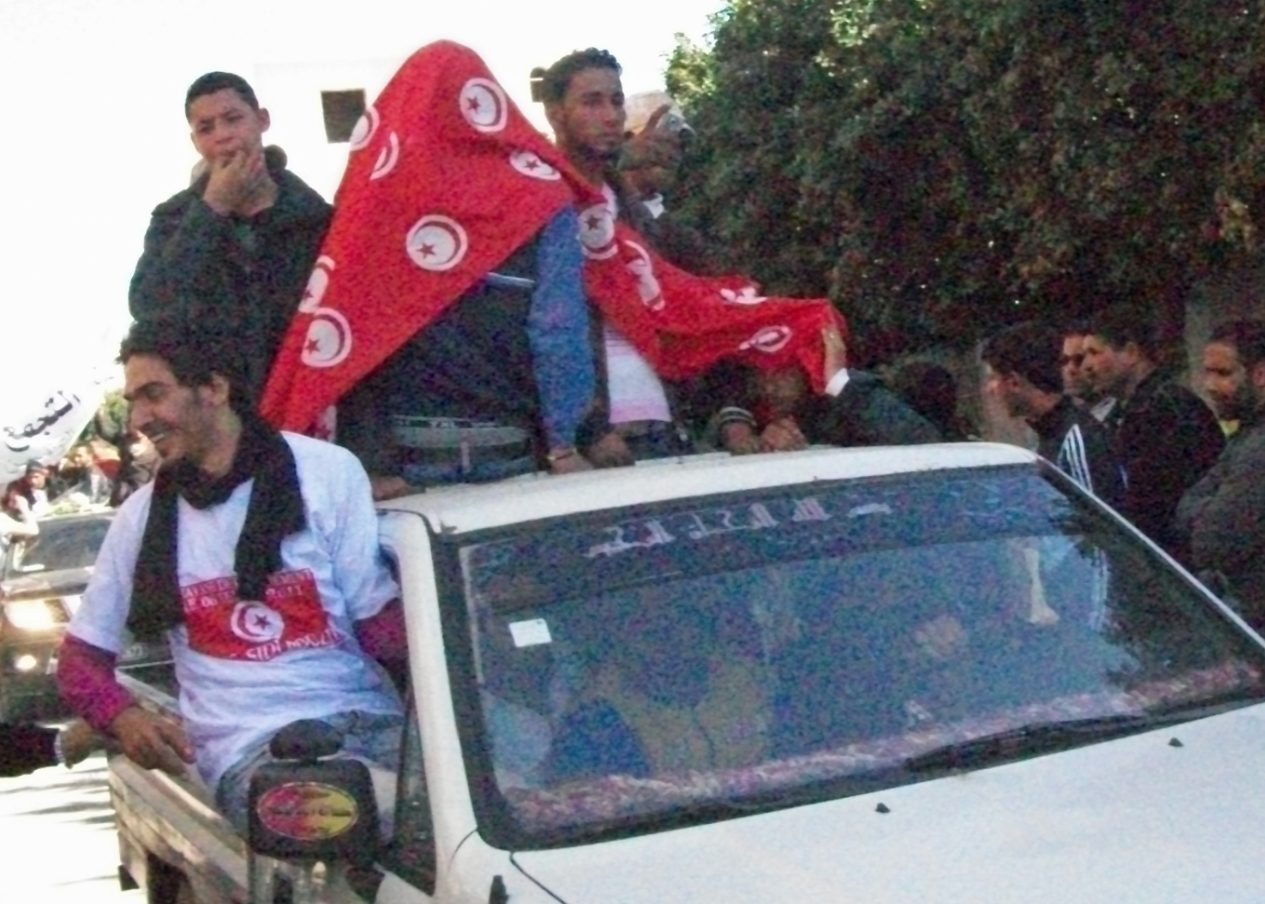
Sidi Bouzid - the city behind the Tunisian revolution. Crédits: Wikimedia commons
The transition through unprecedented pluralism towards a major constitutional compromise
Although the demonstrations forced Ben Ali and his family out of Tunisia, no form of political succession emerged. Despite the return from exile of opponents of the Ben Ali regime, including the return of Rached Ghannouchi on January 30, founder of the Islamist Ennahdha party, the party positioned itself as a political force in a landscape paralyzed by internal divisions among secularists. This first phase of the transition transformed the fall of the regime into a democratic experiment through free elections, constitution-making, and the search for a compromise between Islamists and secularists.
Thus, after several months of political uncertainty and the reshaping of political orders, the transitional government announced a phase of elections, a first for modern Tunisia. The October 23, 2011 elections, presented as the first free legislative elections in contemporary Tunisian history, opened the constituent phase. The Ennahdha party won 89 of the 217 seats in the National Constituent Assembly, but without an absolute majority. Following these elections, on December 12, 2011, Moncef Marzouki, founder and president of the Congress for the Republic (CPR) from 2001 to 2011, was elected President of the Republic by the Constituent Assembly. On December 24, 2011, Hamadi Jebali, a leading figure of the Ennahdha movement, formed a coalition government known as the “Troika,” together with the Congress for the Republic (29 seats) and Ettakatol (20 seats).
This configuration shows that Tunisian pluralism was structured from the outset around negotiation rather than the hegemony of a single actor. Yet the constitutional process of 2012 raised concerns for the democratic transition, with increasingly visible political and social tensions throughout the year. These tensions crystallized around the political assassinations of 2013, with the assassination of Chokri Belaïd, founder of the Unified Democratic Patriots Party and a Tunisian lawyer, allegedly organized by the Islamist party. These major destabilizing events on the political scene led to tensions between parties and social protests. Then, on July 25, the assassination of Mohamed Brahmi, a politician and founder of the People’s Movement (Echaâb), under similar circumstances, constituted the second major shock of the year and further intensified the crisis.
In this climate of tension, political assassinations, and the rise of the jihadist threat, the Constituent Assembly adopted a new Constitution during the night of January 26, 2014, by 200 votes to 12. The text established the Second Republic and enshrined a balance between fundamental rights, pluralism, and the separation of powers: “The 2014 Constitution was the result of an agreement between the two blocs, conservative and secular.” This was followed, on February 3, 2014, by the establishment of the government of Mehdi Jomâa, successor to Hamadi Jebali as head of government, which emerged from a transitional compromise, and by legislative elections won by the Nidaa Tounes party. These first elections, held on October 26, 2014, under the rules of the new Constitution, preceded the election of Béji Caïd Essebsi, founder of the Nidaa Tounes party, as President of the Republic on December 21, 2014.
What the first years of the revolution demonstrated was the plurality of opinions fragmented by the fall of Ben Ali’s rule in Tunisia. The inability of Tunisians to identify a leader unanimously, or at least by a majority, reveals the complexity of constructing a national identity. Although the 2014 Constitution provided a degree of stability after the turbulent early years, political time did not resolve the question of the Tunisian economy, which continued to decline, with GDP falling by 2.9%.
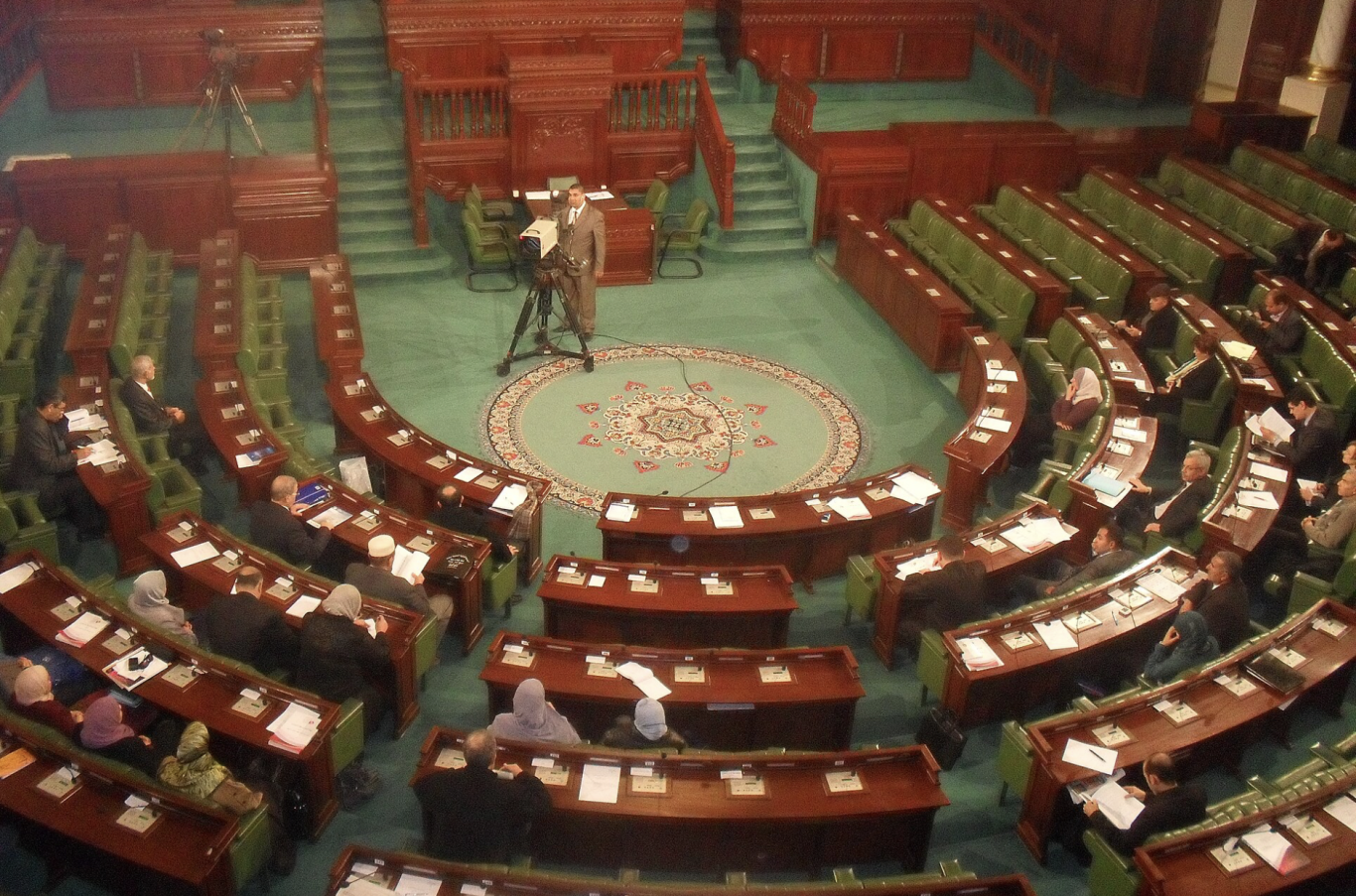
Tunisian MPs dispute sharia in new constitution, crédits: Wikimedia commons.
An unfinished democratic consolidation as political compromise fails to resolve the social and institutional crisis
In 2014, Tunisia believed it had at least temporarily resolved the political question. Yet although between 2014 and 2019 it built pluralist institutions and achieved important legal advances, the absence of socio-economic solutions and institutional deadlock gradually discredited the democratic order established after 2011.
After 2014, the democratic transition continued within a pluralist framework: Nidaa Tounes won 86 seats and Ennahdha 69 seats, and their alliance controlled more than 70% of Parliament, which could have enabled the completion of institutional reforms, but their positions clashed on virtually every issue. This period saw several notable advances, such as the adoption in 2017 of a law against violence against women, the approval in 2018 of a law against racial discrimination, and the holding of the country’s first local elections as part of the decentralization process. This period therefore witnessed a genuine political revival: “The democratic transition project was to experience considerable effervescence,” with legislative reforms in 2017 and 2018.
Yet Jaldi and Akrimi show that most constitutional checks and balances were never established, while the economic transition remained the “Achilles’ heel” of the democratic order. The 2019 elections illustrated the exhaustion of the party system: Ennahdha declined from 89 seats in 2011 to 69 in 2014 and then 52 in 2019, while Kaïs Saïed was elected with 72% of the vote, against a backdrop of growing distrust toward traditional political parties.
The Tunisian case thus shows that a democratic transition can produce genuine freedoms and unprecedented pluralism without succeeding in converting these gains into political stability and lasting social progress. Yet, “in return […] the constitutional institutions of institutional checks and balances […] largely failed to materialize.” Kaïs Saïed, a university professor specializing in constitutional law and president of the Tunisian Association of Constitutional Law from 1995 to 2019, ran as an independent candidate in the 2019 presidential election. His campaign was based on an image of integrity and an anti-establishment discourse that appealed to an electorate disillusioned with traditional political parties. He won the second round against businessman Nabil Karoui with approximately 72.7% of the vote, entering the Carthage Palace in October 2019.
The first two years of his presidency unfolded within the framework of the 2014 Constitution, with a parliamentary system and a government led by the head of government. However, Tunisia experienced a major health and political crisis in 2021, accompanied by growing social tensions and institutional deadlock. On July 25, 2021, Kaïs Saïed carried out a power grab by freezing Parliament’s activities, dismissing the head of government, and assuming full powers through presidential decree. He declared a state of exception and suspended parliamentary immunity, justifying these measures by the need to fight corruption and save the country from chaos.
This authoritarian turn marked a break with the democratic process initiated after the 2011 revolution and sparked strong criticism from the opposition, civil society, and international partners. In 2022, Kaïs Saïed had a new Constitution adopted by referendum, replacing the 2014 Constitution. The new Constitution is characterized by a greatly strengthened executive power, referring to Islam as an objective of the state and a source of law, in a process contested by the opposition, which denounced a referendum organized under irregular conditions. This new presidential system concentrated most powers in the hands of the head of state, considerably weakening Parliament and judicial independence. This period also witnessed increased repression of the opposition and critical voices, with the arrests of journalists, political opponents, and members of civil society.
Economically, the Kaïs Saïed period has produced a mixed-to-negative record. Public debt, which stood at 67.8% of GDP in 2019, reached 84.9% in 2024, its highest level since independence, before falling slightly to 82.1% in 2025. The Tunisian economy has not experienced significant growth and has lost some of its standing with international institutions, with relative performance below that of comparable countries such as Morocco, Jordan, or Senegal. The budget deficit, which had been reduced from 6% of GDP in 2016–2017 to 3.9% in 2019 through consolidation measures under IMF supervision, deteriorated again.
Kaïs Saïed was re-elected on October 6, 2024, for a second term, consolidating his control over Tunisia’s institutions. What, then, should be remembered from the revolution? What should be made of a process lasting more than ten years that failed to provide lasting democratic solutions? What should be made of ten years of economic difficulties in a country that had been the IMF’s model student under Ben Ali’s dictatorship? One of the first possible answers lies in a Tunisian trajectory showing that the success of a democratic transition depends not only on holding free elections or adopting a Constitution, but also on the ability of new institutions to respond to the social demands that drove the revolution.
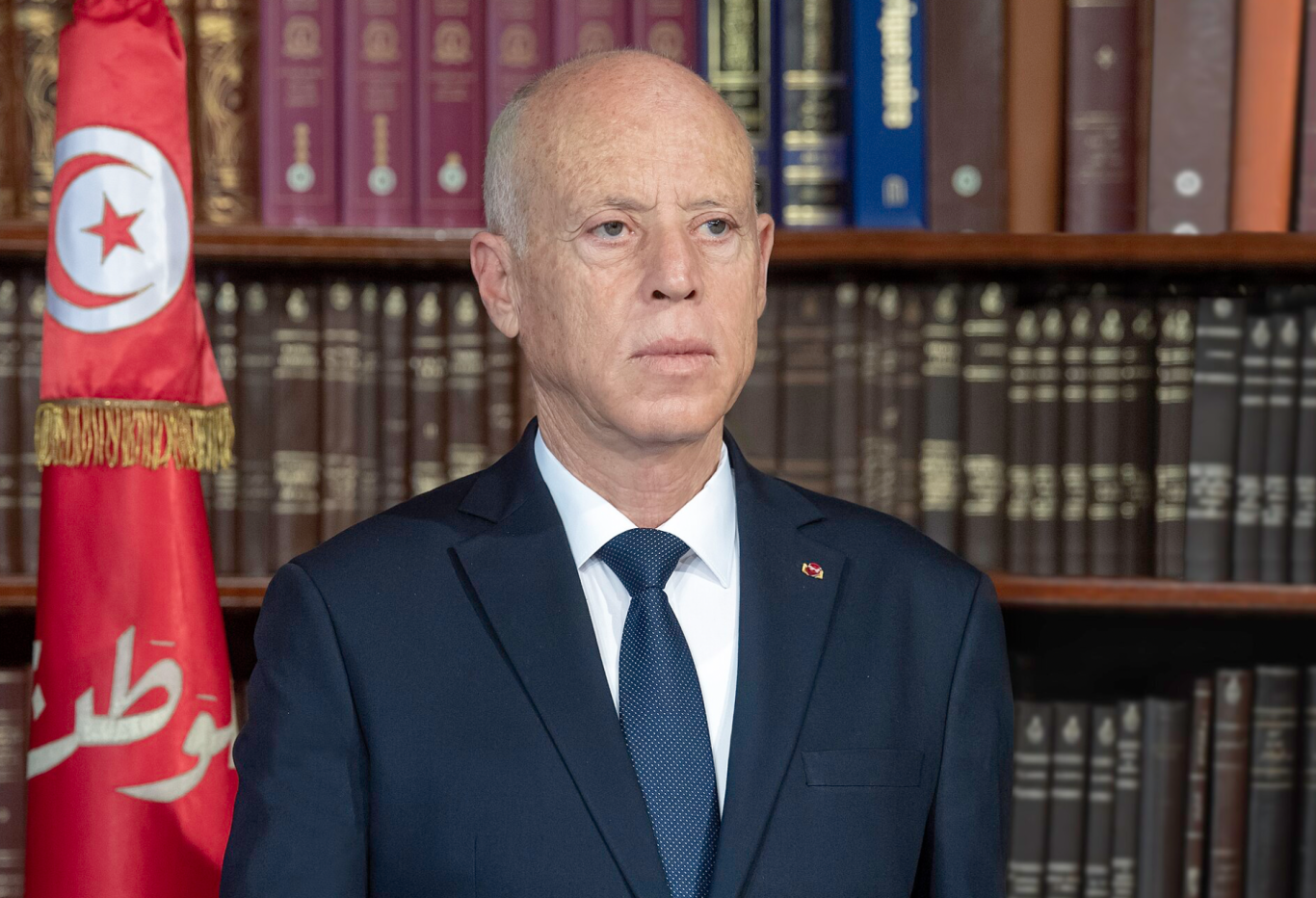
Kaïs Saïed. Crédits: Wikimedia Commons.
In 2026, five years after the constitutional coup of July 25, 2021, Tunisia is facing a confirmed authoritarian drift and strong social tensions, notably linked to power cuts, interruptions in running water, and shortages in drinking-water supply chains. The country is experiencing growing popular discontent, with demonstrations against deteriorating living conditions and the concentration of power in the hands of the president. Kaïs Saïed’s sovereigntist rhetoric and demagogic speeches do not resolve the country’s economic and social problems, and are pushing Tunisia toward a recessionary economy without foreign investment.
The 2011 revolution did indeed constitute a moment of rupture in Tunisia. It brought an end to one of the most tightly controlled authoritarian regimes in the Arab world, opened up an unprecedented pluralist space, and led to the adoption of a democratic Constitution that, for several years, appeared to make Tunisia a regional exception. In this respect, the Tunisian transition cannot be reduced to an insignificant interlude: it transformed forms of political participation, legitimized new actors, and brought into the public sphere demands that had long been suppressed.
Yet this rupture never erased the deep structures of the Tunisian political order. The legacy of a centralized state, the weakness of partisan mediation, the failure to establish effective institutional checks and balances, and the absence of a lasting response to the social crisis weakened democratic consolidation. In this sense, the transition revealed a tension running throughout the country’s contemporary history: the aspiration for political freedom repeatedly comes up against the strength of an image of the state as protective, hierarchical, and embodied in a strong leader.
The Tunisian experience thus reminds us that the strength of a democracy depends on the ability of institutions to generate trust, reduce social divides, and embed pluralism durably in the ordinary practices of government. While the decade opened by 2011 demonstrated that authoritarianism was not inevitable, more recent developments indicate that no democratic achievement is irreversible when the social promises of the revolution remain unfulfilled.