Syria : what peace costs Syrians.
Interview with Benjamin Fève, consultant and independent researcher, specialised on Syrian economy and founder The Syria Dispatch.
Interview conducted by Victor Jardin on 13 November 2026. Quotations have been translated from French and lightly edited for the written format.
Two years after the fall of Bashar al-Assad, a rise in diesel prices sent thousands of Syrians into the streets in September. According to economist Benjamin Fève, reconstruction rests first and foremost on households, while a cash-strapped state is liberalising “from the wrong end”.
On 13 September 2026, the price of a litre of diesel rose from 125 to 175 new Syrian pounds, a 40% increase overnight. In the following days, roads were blocked from Hasakah to Raqqa, from Deir ez-Zor to Hama, and as far as Azaz and al-Bab. These were the largest demonstrations since the fall of the regime. Four days later, the government partially backtracked, introducing three different pricing tiers, including a reduced rate for the poorest households.
To understand this anger, one must look back at the economy inherited from the former regime. For decades, the Ba’athist state had purchased social peace through subsidies on bread, fuel and electricity. War, sanctions and the collapse of the Syrian pound subsequently destroyed that social contract. Today, approximately 90% of Syrians live below the poverty line. Since December 2024, the new authorities, shaped by their experience in Idlib, have opted for economic openness: liberalising imports, securing the gradual lifting of Western sanctions in 2025, and calling on investors to return. The bill is enormous: the World Bank estimates the cost of reconstruction at $216 billion.
An independent consultant and researcher specialising in the Syrian economy and founder of The Syria Dispatch, Benjamin Fève spends approximately one-third of his time in the country. His assessment is unequivocal: for now, it is Syrians themselves who are financing peace.
Who is paying for Syria’s reconstruction, and who stands to benefit?
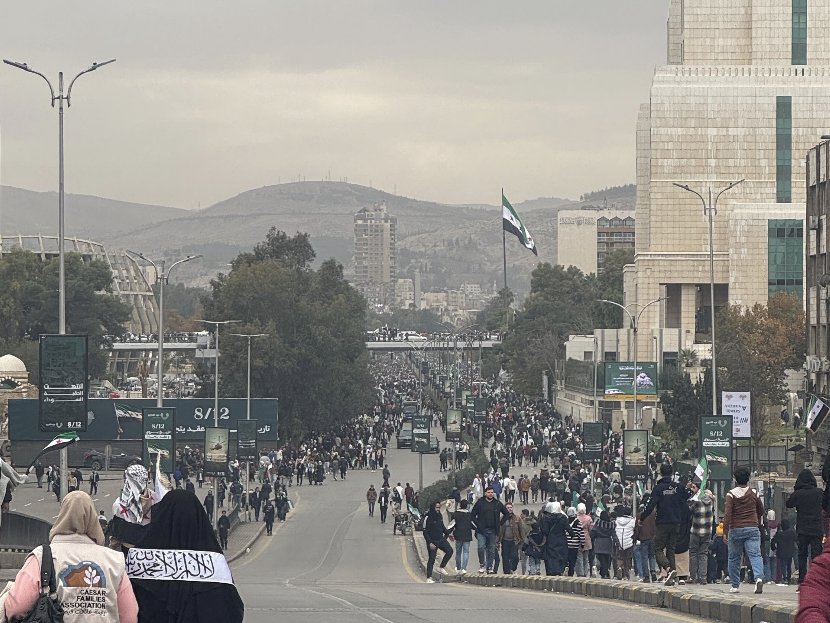
Damascus, december 2025 : Syrians celebrating the first anniversary of Al-Assad regime's fall. Credits: B. Feve
Diesel prices: a reflection of a state that can no longer afford to pay
A price shock with no safety net
In Syria, fuel prices are not like any other prices: they determine the cost of heating, transport and bread. Yet September’s increase was only the latest in a series of hikes. Since February, Benjamin Fève points out, diesel prices have more than doubled, while Brent crude has risen by just 44% over the same period. Diesel remains the country’s primary heating fuel.
“A family needs around 150 litres a month during winter. Even at the subsidised rate, that amounts to 17,250 pounds, compared with a minimum monthly public-sector salary of 12,560 pounds,” he calculates. He offers a telling comparison: “In France, it would be like paying €1,300 or €1,400 a month for heating. The Yellow Vest movement started over a few cents on fuel.”
Why take such a risk? “If the government did it, it was because it could no longer afford to pay,” he says bluntly. In 2026, the Syrian Petroleum Company was transferring approximately $250 million a month to the Treasury, helping to finance, among other things, increases in public-sector salaries. Its losses brought those transfers to an end. The Qatari gas donation also stopped in August, adding approximately $140 million a month to the state’s financial burden. Even at 175 pounds per litre, diesel is still being sold at a loss.
North-East Syria: the losers of integration
For north-eastern Syria, integration into the state has initially meant economic losses. Every summer, the Autonomous Administration distributed 300 litres of heating diesel per family, at 11 pounds per litre. This allocation disappeared when public services were transferred to Damascus, and nothing has replaced it since.
“Some families are now burning cotton waste, old clothes or dried animal dung,” reports Benjamin Fève. Farmers in Hasakah and Raqqa are still waiting to be paid for their wheat, whereas under the Autonomous Administration, diesel and seeds arrived on time, and cotton prices were set in dollars.
Administrative integration is nevertheless progressing “far faster than political and economic integration”, he observes. On the Kurdish side, the question is what will remain of the Autonomous Administration’s achievements and what will happen to its civil servants. On the Arab side, tribes have generally welcomed the return of the state, but their expectations are primarily material. It is, moreover, these rural communities, deprived of the income they once earned from now-closed makeshift refineries, that blocked crude oil trucks in September.
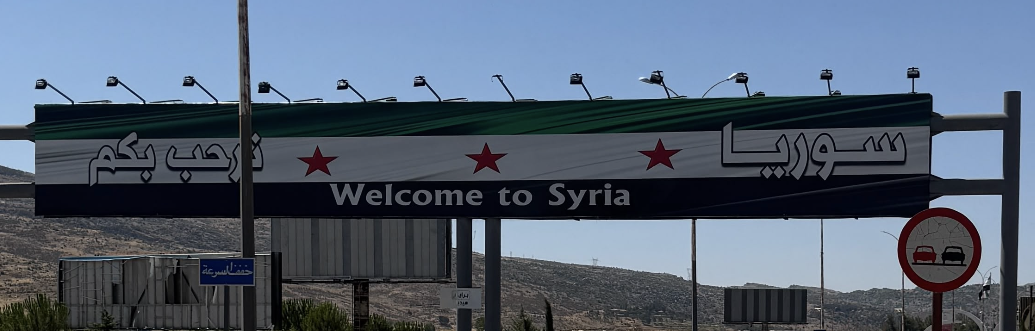
Credits: B. Feve
Liberalising from the wrong end: applying the Idlib model to the entire country
Damascus adopts the Idlib approach
It is not Idlib that has been integrated into Damascus; rather, Damascus has been integrated into Idlib’s economic model. Between 2017 and 2024, the Salvation Government, backed by Hayat Tahrir al-Sham, managed an open economy there: limited state intervention, liberalised imports and virtually no subsidies. Since the fall of the regime, this model has been applied to the entire country.
“It is the Idlib approach that has prevailed, and Damascus’s industrialists have been disadvantaged by this integration,” explains Benjamin Fève. Imports generate customs duties, which accounted for 40% of public revenue in the first half of 2026, compared with just 9% from taxes. But they also expose domestic industry to Turkish competition.
According to him, the problem is not the direction of reform, but its sequencing. “Syria is liberalising from the wrong end,” he summarises. The three-tier pricing system illustrates this perfectly: six weeks after its announcement, subsidised diesel had still not reached households. “Prices went up first, and the safety net was improvised afterwards, at the beginning of winter.”
What would be the right approach? First, establish the social safety net, then raise prices: publish a pricing formula and a timetable for phasing out subsidies, and provide direct assistance to the poorest households, drawing on the beneficiary databases of UN agencies, which have been present in the country for more than fifteen years. That would, however, require the government to ask for help. Yet “the authorities are somewhat reluctant when it comes to aid,” he notes. They want to shed the image of a country dependent on external assistance and prefer to talk about investment.
Austerity undermines reconstruction
The government has chosen to cut spending rather than print money, but the cuts are falling precisely where reconstruction begins. The 2026 budget provided for $10.5 billion in expenditure and a deficit of $1.8 billion. By the end of the first half of the year, the deficit had already reached approximately $1 billion, or 57% of the annual allocation.
Faced with such a budget overrun, fragile states generally have two options: accumulate arrears with suppliers or turn on the printing presses. Damascus has rejected the latter, which Benjamin Fève welcomes as a break with the former regime.
The question, however, is where the savings are being made. Public-sector salaries, which account for 36% of expenditure, are politically untouchable. Public investment is therefore bearing the brunt. “And that is precisely the part of the budget most closely linked to reconstruction,” he concludes.
Can a state ask its population to pay more while simultaneously giving up on rebuilding the country?
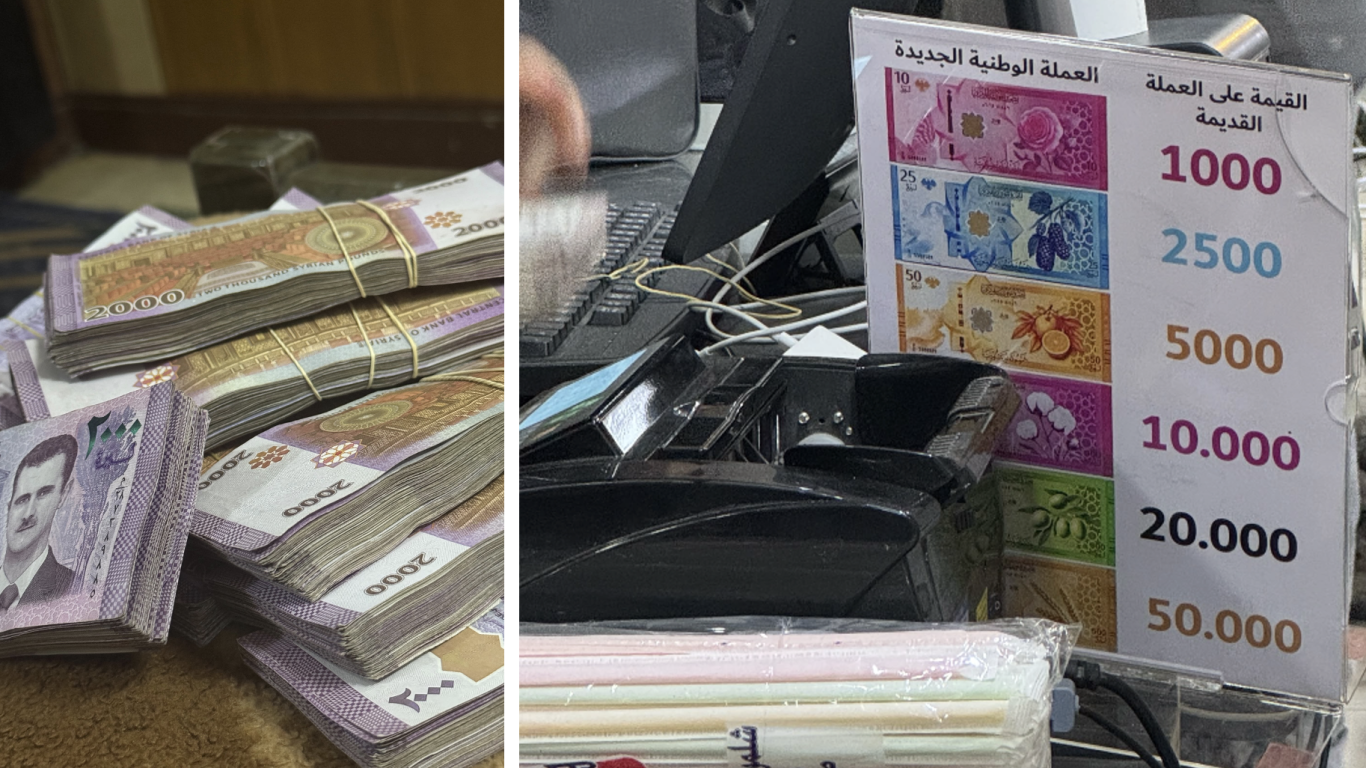
Left: the Assad regime's currency. Right : exchange rate between the old and the new money. Credits: B. Fève
Bottom up reconstruction, without credits or investors.
Syrians: the first builders
Those rebuilding Syria are first and foremost Syrians themselves. Cement consumption has returned to nearly its 2010 level. Yet, Benjamin Fève warns, “that was the level of an ordinary developing country, not that of a country in need of reconstruction.” According to the Ministry of Public Works, 1.32 million of the country’s 4.25 million housing units are damaged, and Syria will face a shortage of 2.5 million homes by 2030. The official target of building or rehabilitating two million homes by 2035 would, in his estimation, require approximately three million additional tonnes of cement per year.
So who is doing the building? Returning families, household savings and money sent by the diaspora. Foreign companies, meanwhile, are almost entirely absent: most memoranda of understanding signed over the past eighteen months have yet to materialise. Bank lending is virtually non-existent. “It accounts for approximately 4% of GDP, compared with 23% before the war,” he recalls. In other words, reconstruction is not being financed through credit: it is being carried out with whatever people have in their pockets. The country’s first syndicated loan illustrates the scale of the problem: three of Syria’s largest banks pooled $25 million. Against reconstruction needs estimated at $216 billion, that is a drop in the ocean.
Damascus, the showcase of reconstruction
State-funded reconstruction begins with the showcase projects. This loan is financing a tunnel in the capital and the “Qasioun Journey” tourism project on Mount Qassioun, which overlooks the city. The first post-Assad real estate loan, meanwhile, targets Marota City. This flagship project of the former regime was launched under Decree 66 of 2012, covering informal neighbourhoods whose residents were expropriated.
Benjamin Fève takes a pragmatic position: “The houses have been demolished, the populations displaced, and towers have already been built. There is no going back.” The project must therefore be completed, he argues, and its revenues used to compensate families. The decree had already promised shares to property owners and replacement housing to other residents. “In practice, many received nothing, while others saw the value of their shares collapse with the Syrian pound,” he notes. He proposes identifying beneficiaries using land registry records dating from before 2012, allocating a share of sales proceeds to a compensation fund, and indexing compensation amounts to the dollar. To his knowledge, the government has yet to announce any such measures.
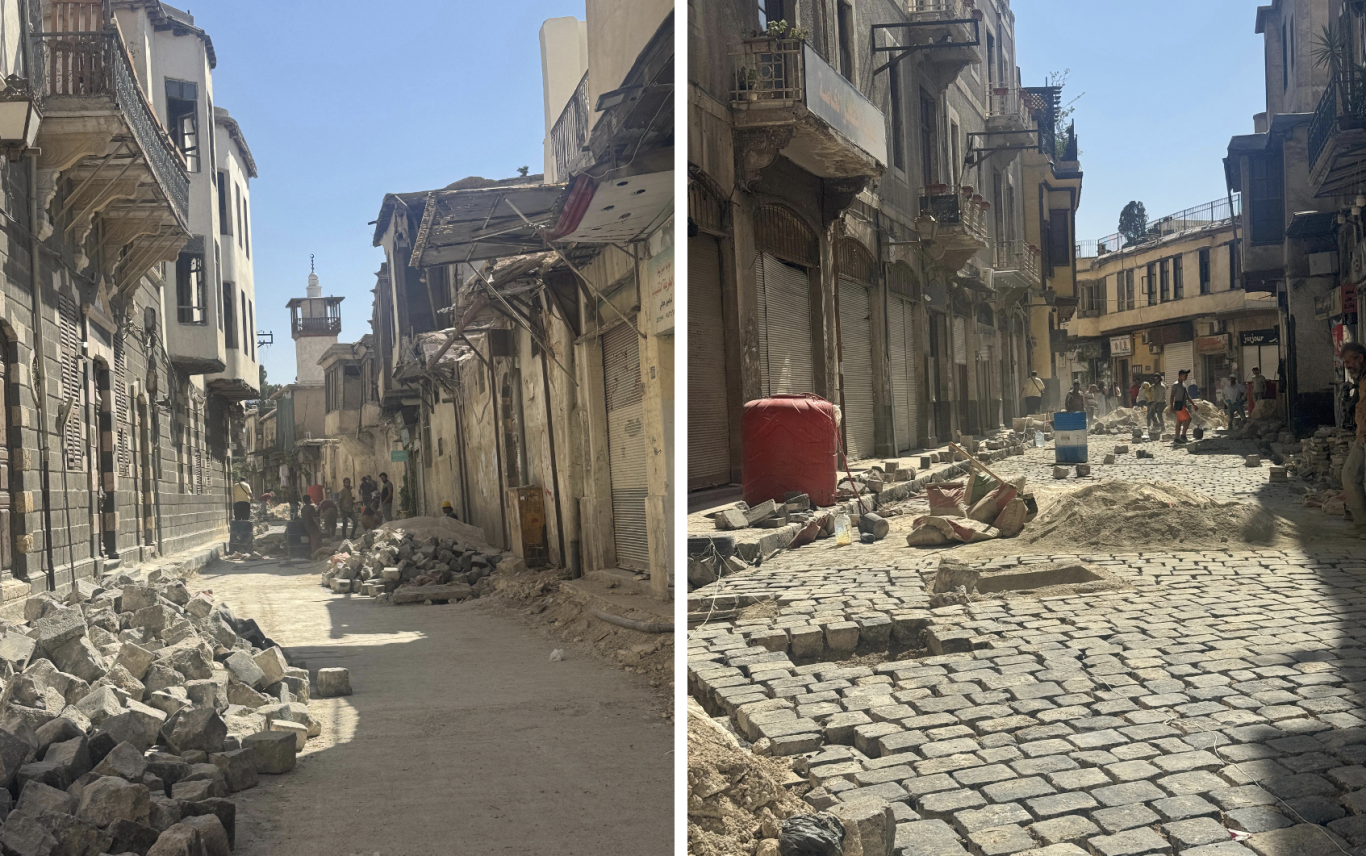
Damascus old city : the new regime removed the paving stones to rehabilitate the underground pipes and electrical system. Credits: B. Feve.
At the top, economic power is becoming increasingly concentrated
The Idlib circle takes control
The October reshuffle may have clarified the chain of command, but it has also narrowed the circle of economic power. Within two days, Ahmad al-Sharaa appointed a new Minister of Industry, Basel Abdul Hannan, and a new head of the petroleum company, Maher al-Hassan, following a scandal involving substandard petrol. The sovereign wealth fund also changed leadership: Omar al-Halabi, formerly of the Saudi sovereign wealth fund, became its chairman while simultaneously taking on the role of economic adviser to the presidency. Two of these three men, however, come from the Economy Ministry of Idlib’s Salvation Government. Benjamin Fève sees this as evidence that al-Sharaa’s close associates are replacing officials who had no ties to Hayat Tahrir al-Sham.
Nevertheless, he cautions against drawing one-sided conclusions. At the petroleum company, nobody seemed to know exactly who had the authority to sign contracts anymore. Appointing someone closer to the president could help clarify matters. The revolving door of senior officials nonetheless comes at a cost: “Foreign partners have sometimes had to change their main point of contact several times within a single year,” he observes.
Contracts without competitive tenders
Urgency justifies practices that open the door to arbitrariness. Benjamin Fève recalls that the Energy Minister was very clear when addressing Parliament. On the one hand, certain contracts are awarded on political grounds: attracting major companies such as ConocoPhillips, Chevron or TotalEnergies to reassure other investors. On the other hand, the urgency of the situation justifies direct contracts without competitive tenders. “You cannot wait three months for a tender when power plants need diesel,” he concedes. But combining these two approaches “leaves considerable room for abuse” if oversight is ineffective.
The sovereign wealth fund has become a focal point for these concerns. Attached to the presidency and headed by a chief executive under Australian sanctions, it now sees its chairman become an adviser to the head of state, contrary to international standards. “It is potentially a major player, but so opaque that foreign partners are hesitant to work with it,” he points out. The public report promised within 90 days should reveal which assets it holds and how they were acquired.
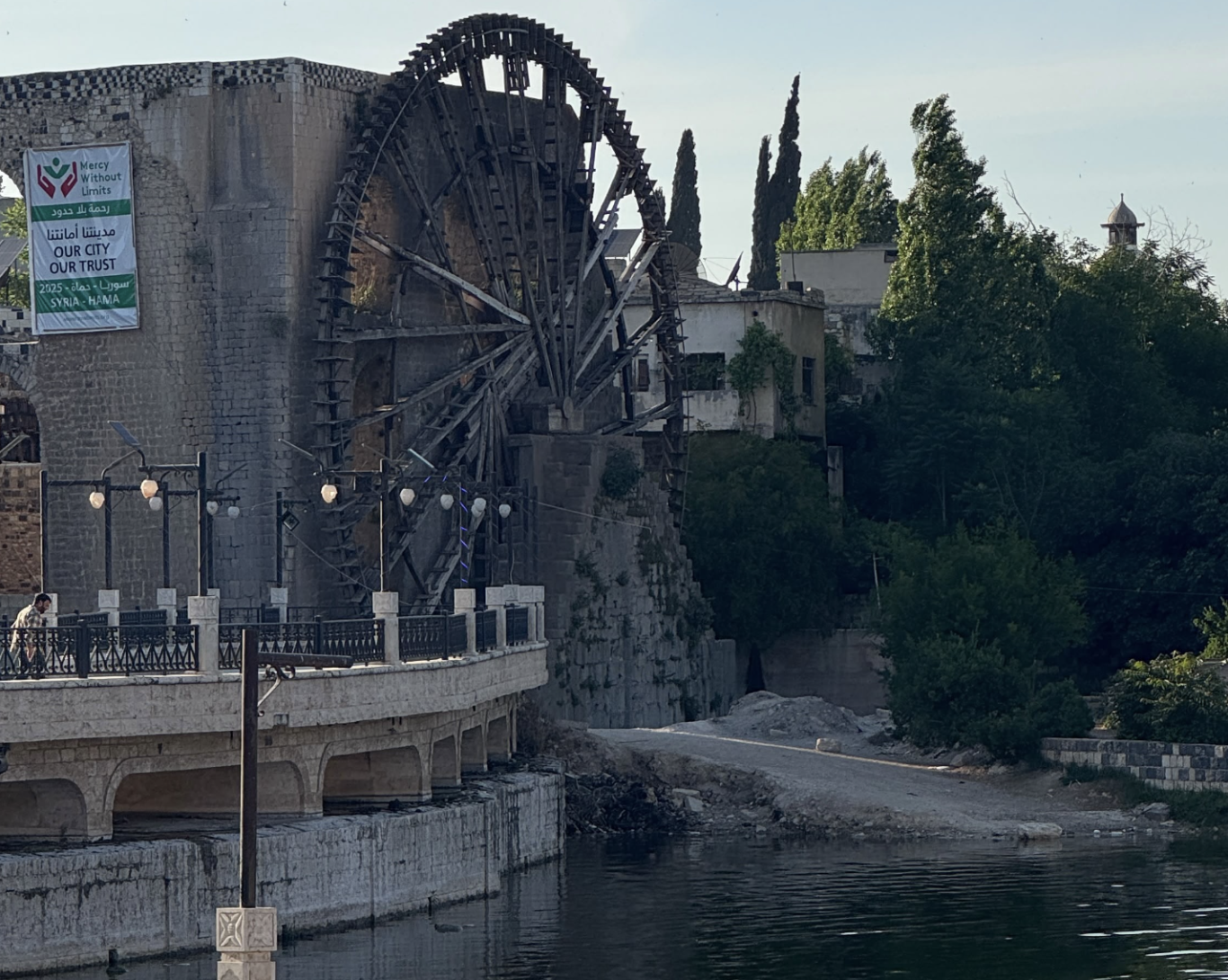
Hama old city. The Hama river is often dry, which is a water problem for the new administration. Credits: B. Feve
A Syria reconnected to the world, but not yet normalised
The real banking test is still ahead
The lifting of sanctions has transformed the country’s prospects far more than the lives of its inhabitants. In October, the Central Bank opened its first letter of credit in fourteen years, confirmed by JPMorgan, to import 65,000 tonnes of Saudi diesel. The signal is significant. But it was the Central Bank that opened this letter of credit, not a commercial bank. “The real test will be a bank in Damascus opening a letter of credit for a private industrial company, without the Central Bank standing behind it. And that has not happened yet,” Benjamin Fève emphasises.
His field research, conducted in October, confirms this: none of the companies interviewed had opened a letter of credit with a Syrian bank. One distributor even estimated that it was losing 30% of its sales volumes because of payment constraints. For ordinary Syrians, the effects of sanctions relief remain limited. It is primarily internationally oriented businesspeople who are benefiting. Most Syrians, after all, do not have a bank account or do not use one. Public-sector employees, who are paid through the Commercial Bank of Syria, do have accounts. “But as soon as their salaries arrive, they withdraw everything in cash,” he explains. The Syrian economy remains a cash-based economy. “What is really changing are the prospects: Syria is no longer isolated and is becoming attractive again.”
Europe and its implicit red lines
Europe imposes few conditions, but not none. Faced with Gulf investment, the European Union has limited leverage to impose strong conditionality: it must remain accommodating if it wants to maintain a foothold in Damascus. Does that mean it has no red lines? No, answers Benjamin Fève. “Red lines are always, ultimately, implicit.”
He recalls that before 2011, the European Union was negotiating an Association Agreement with Bashar al-Assad’s Syria. “Nobody told Bashar al-Assad in 2011 not to repress his own people. He did so, and the European Union reacted.” Today’s authorities understand, in much the same way, what they can and cannot do.
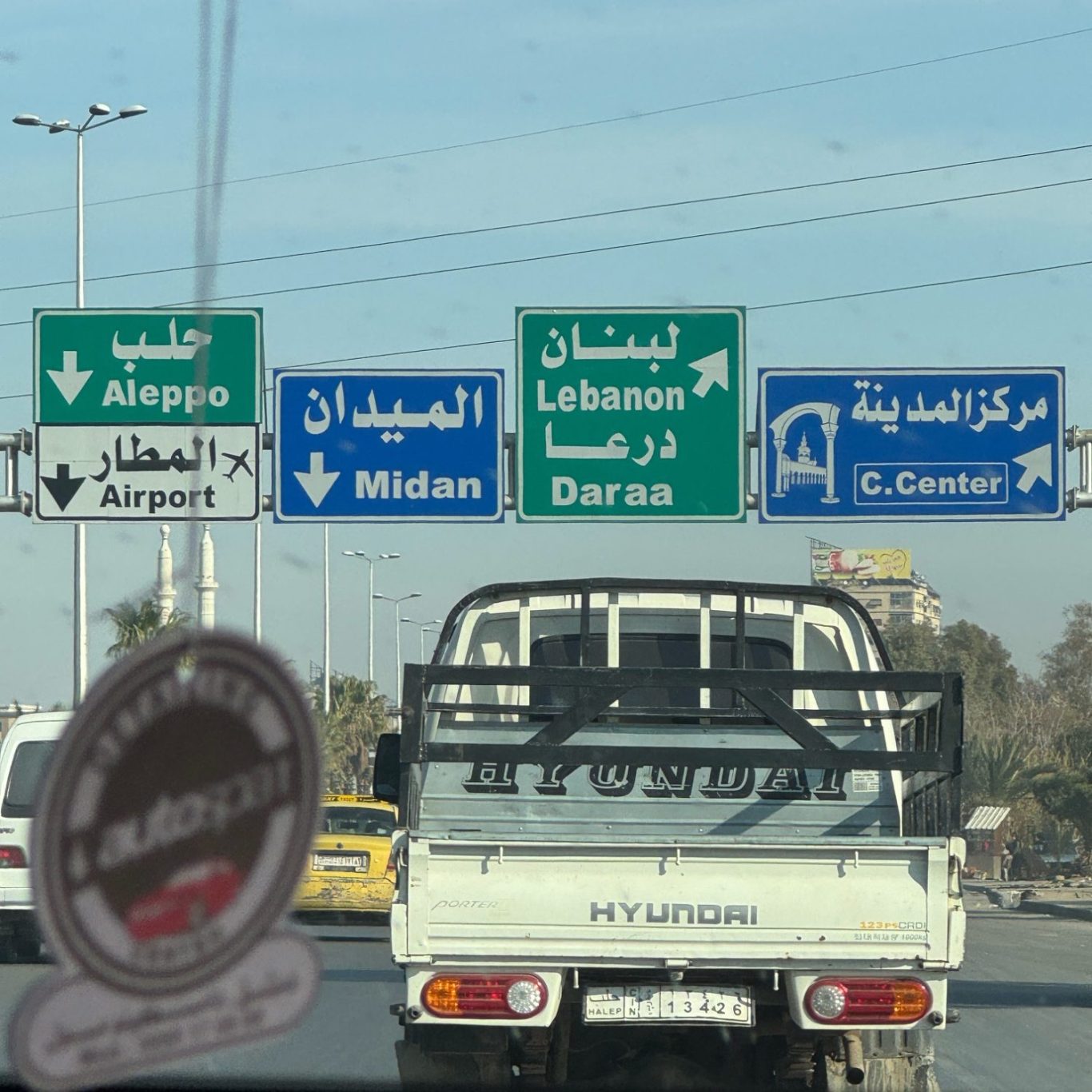
Route directions after crossing the Syrian border. Credits: Benjamin Feve
Ultimately, Syria is being rebuilt first and foremost by its own people, while the state withdraws from the economy and those in power close ranks. At the top, Ahmad al-Sharaa remains “the undisputed leader”, Benjamin Fève believes, despite tensions between conservatives and liberals, and between Syrians who remained in the country and those who returned from exile. He praises the government’s handling of the September demonstrations, which took place without violence: “a very welcome change.”
In Suwayda, however, violence has subsided without the conflict being resolved. Local security arrangements, the position of Druze authorities vis-à-vis Damascus, and justice for victims all remain unresolved.
The main weakness lies elsewhere: in the coordination and predictability of public policy. The restrictions on alcohol in Damascus, withdrawn following protests, and the new school textbooks, defended by the Ministry of Education despite criticism, are cases in point. “What worries me most is the unpredictability of decisions,” he confides. Investors he advises are now preparing for two scenarios: one in which the rules remain stable, and another in which they change overnight.
Above all, time is running out. “2027 must be the year in which the government focuses on improving living conditions. Otherwise, it will find it difficult to continue benefiting from this post-conflict legitimacy.” Can a government retain the legitimacy of victory for long when it is the population itself that is paying for peace?
Sources complémentaires : Banque mondiale (coût de la reconstruction) · The National (logement) · The National(budget 2026) · Syria Dispatch (manifestations de septembre) · Syria Dispatch (audition du ministre de l'Énergie) · Qatar Tribune (Qasioun Journey) · Al-Monitor (manuels scolaires)